
Affiliate Disclosure: As an Amazon Associate, ShredProInk earns from qualifying purchases. We may earn a commission if you buy through our links, at no extra cost to you.
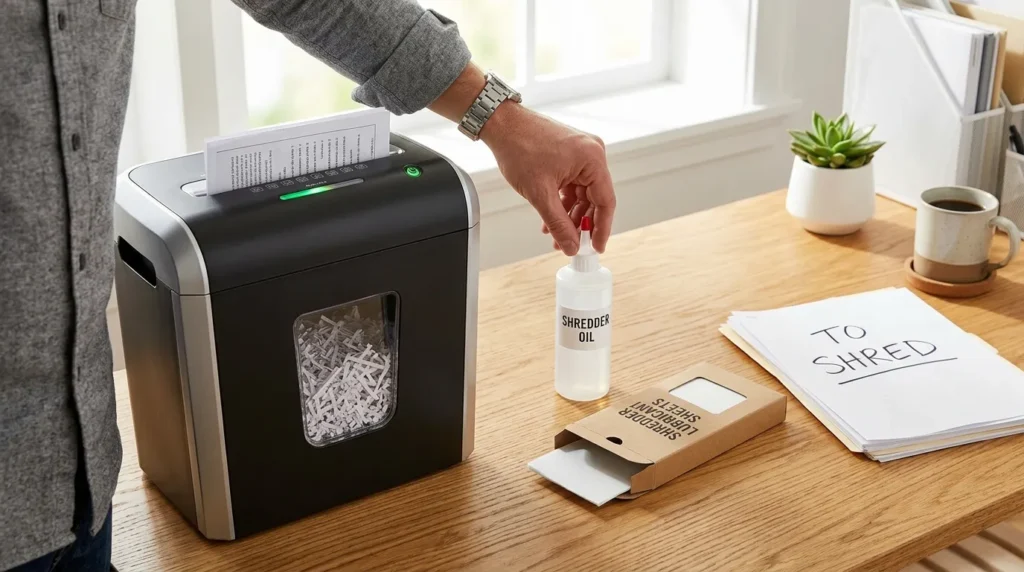
A paper shredder needs lubrication because its cutting head contains moving blades that work against paper fibers, dust, and friction. How to oil a paper shredder depends on the model, so the manufacturer’s instructions should always come first.
For many frequently used cross-cut shredders, oiling around the time you empty the waste bin is a practical maintenance trigger. Other machines specify a monthly interval or use an automatic oiling system. Fellowes, for example, recommends regular oiling for its cross-cut machines and provides different forward or reverse procedures depending on the shredder design.
At ShredPro Ink, we organize this routine as Check → Empty → Lubricate → Distribute → Clear → Resume. It gives you a simple way to maintain the machine without treating oil as a cure for every shredder problem.
Quick answer: Turn the shredder off, use the lubricant approved by the manufacturer, apply it according to the model’s instructions, then run the specified forward or reverse cycle. Never assume every shredder uses the same oiling procedure.
Why Does a Paper Shredder Need Oil?
The cutting head contains multiple moving cutters that pull paper through the feed opening. As you shred documents, paper dust and residue can collect around those cutters.
That buildup can increase friction and make the machine work harder. Manufacturer documentation links inadequate lubrication with symptoms such as reduced sheet capacity, louder operation, and increased operating problems.
Lubrication helps keep the cutting components moving as intended. It is one part of paper shredder maintenance, alongside emptying the waste bin, keeping the feed area clear, observing the duty cycle, and addressing recurring jams.
This matters most when you use a shredder frequently. A home-office user who shreds a few envelopes each week has a different maintenance pattern from a small office processing confidential paperwork every day.
It also matters more with machines that produce very small particles. Cross-cut and micro-cut shredders have more complex cutting arrangements than basic strip-cut machines, so you should follow the maintenance instructions written for your specific model.
The goal isn’t to pour oil into the machine as often as possible. The goal is to use the right lubricant at the right interval and in the right way.
How to Oil a Paper Shredder
The exact procedure varies by design. Some manufacturers instruct users to apply oil across the paper entry and run the machine in reverse. Other models use a forward cycle, lubricant sheets, or an automatic oil reservoir.
Use this general process only as a framework. Your owner’s manual takes priority.
What You’ll Need
- Manufacturer-approved shredder oil or compatible lubricant
- Lubricant sheet, if your machine supports that method
- Clean scrap paper, if the manufacturer’s procedure calls for it
- A cloth for wiping visible residue
1. Empty the Shredder Bin
Empty the waste bin before lubrication if the manufacturer’s instructions use bin-emptying as the maintenance trigger.
A full bin can restrict normal operation and makes it harder to tell whether a performance problem comes from the cutting head or simple overfilling.
2. Turn the Shredder Off
Set the machine to OFF before applying bottled oil or accessing areas specified by the manufacturer.
Some larger machines have different maintenance procedures, so don’t remove a shredder head, open a cabinet, or reach into the cutting area unless the manual specifically tells you to do so.
3. Apply the Approved Lubricant
Apply the lubricant across the paper entry or cutting area according to the manufacturer’s instructions.
For example, Fellowes’ guidance for several lift-off-head models calls for the shredder to be OFF while oil is applied across the paper entry. Its manuals specify non-aerosol vegetable-based shredder oil for applicable models.
Don’t guess the amount. More oil isn’t automatically better.
4. Run the Specified Forward or Reverse Cycle
This is where model differences matter.
Some Fellowes designs call for reverse for 2 to 3 seconds after oil is applied. Other designs use forward operation for a few seconds. Lubricant sheets can have their own procedure, such as feeding the sheet through and then running reverse briefly.
Follow the sequence in your manual rather than copying the procedure from another shredder.
5. Clear Excess Lubricant
If your manufacturer’s instructions call for clearing excess lubricant, follow that procedure before returning to normal shredding.
Avoid trying to wipe inside the cutting mechanism with your hands or a cloth. The cutters are sharp, and reaching into the feed opening creates an unnecessary injury risk.
6. Resume Normal Use
Return the shredder to normal operation once the lubrication procedure is complete.
Keep the machine within its duty cycle, which is the amount of continuous operation the manufacturer allows before a cooling period. Oiling doesn’t remove the need for cooling.
What Oil Should You Use in a Paper Shredder?
The safest rule is simple: use the lubricant specified or approved by your shredder manufacturer.
Purpose-Made Shredder Oil
Purpose-made shredder oil is usually sold in a squeeze bottle with an extended or precision nozzle. That makes it easier to distribute lubricant across the required area without spraying it around the machine.
Fellowes lists its Powershred Shredder Oil for applicable cross-cut and micro-cut machines and provides dedicated oil products for some higher-capacity machines.
Shredder Lubricant Sheets
Lubricant sheets provide a cleaner, pre-measured alternative. You feed the sheet through the shredder like paper, following the manufacturer’s instructions.
Fellowes lists its Performance+ Lubricant Sheets as a maintenance option for compatible cross-cut and micro-cut shredders.
Why the Manufacturer’s Manual Comes First
Don’t assume that oil approved for one shredder works for every machine.
Manufacturer guidance varies. Some Fellowes documentation specifies non-aerosol vegetable-based oil, while commercial or high-security models can have their own requirements.
Oils and Lubricants to Avoid
Don’t reach for a random household lubricant just because it is nearby.
Aerosol lubricants deserve particular caution. Fellowes explicitly warns against aerosol oil for its applicable shredders and cites fire risk associated with petroleum-based aerosol lubricants.
For the full question of whether a particular household lubricant is compatible, see our guide to safe lubrication alternatives to WD-40.
Shredder Oil vs. Lubricant Sheets: Which Should You Use?
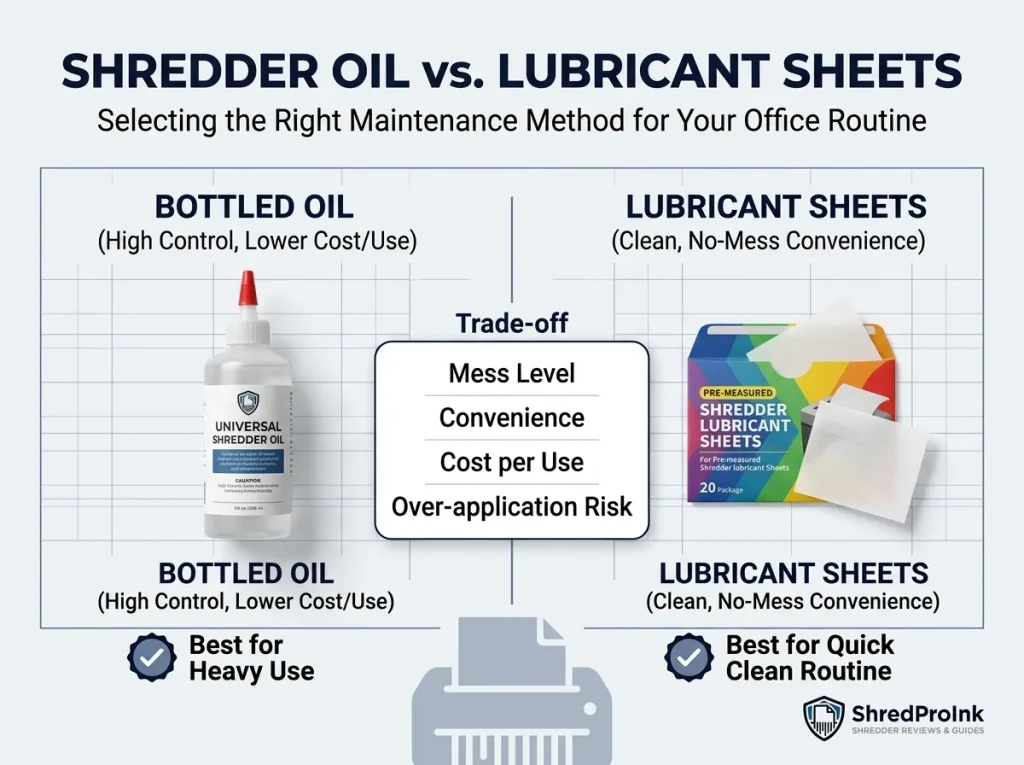
Both methods can work when the manufacturer supports them. The better choice comes down to control, convenience, and your maintenance habits.
| Factor | Bottled Oil | Lubricant Sheets |
|---|---|---|
| Lubrication control | Higher | Pre-measured |
| Mess | Moderate | Low |
| Convenience | Moderate | High |
| Cost per use | Usually lower | Usually higher |
| Best for | Regular or heavier maintenance | Easy routine maintenance |
| Over-application risk | Possible | Lower |
| Storage | Bottle | Individual sheets |
Choose Bottled Oil If…
- You use the shredder often and want a dedicated maintenance bottle nearby.
- Your manufacturer recommends oil and gives a direct application procedure.
- You want lower cost per maintenance cycle than pre-lubricated sheets.
Choose Lubricant Sheets If…
- You want a cleaner process with less handling.
- You don’t want to measure oil or risk applying too much.
- Your shredder supports lubricant sheets as an approved maintenance method.
Choose Automatic Oiling If…
An automatic-oiling machine can make sense for high-volume users who need regular maintenance without stopping to manually apply oil.
Some Fellowes commercial models use an oil reservoir that automatically lubricates the cutters. Their manuals still specify the correct oil and refill procedure, so an automatic system doesn’t mean maintenance becomes irrelevant.
Recommended next step: If you’re deciding between the two manual options, compare our top shredder oil and lubricant sheets before buying.
How Often Should You Oil a Paper Shredder?
There isn’t one universal oiling interval for every paper shredder.
Your maintenance schedule should account for usage, shredder type, manufacturer instructions, and machine design.
| Usage pattern | Practical starting point |
|---|---|
| Occasional home use | Follow the manual; intervals may be longer |
| Regular home-office use | Check the recommended routine and use bin-emptying as a practical trigger when supported |
| Frequent cross-cut use | Some manufacturers recommend oiling whenever the bin is emptied |
| Micro-cut use | Follow the model-specific maintenance schedule |
| High-volume use | Use the manufacturer’s commercial maintenance interval |
| Automatic-oiling model | Refill the specified reservoir as instructed |
Fellowes currently recommends oiling applicable frequently used cross-cut shredders each time the waste bin is emptied, while other documentation specifies monthly maintenance for particular machines.
For the complete frequency breakdown by usage level, see our guide to how frequently to maintain your shredder.
Signs Your Shredder Needs Maintenance
A shredder can give you clues when its maintenance routine has slipped.
The Shredder Sounds Louder Than Normal
A change in operating noise can indicate that the cutters need attention. It can also point to another mechanical or operational problem.
Paper Feeds More Slowly
If the machine suddenly handles fewer sheets or feeds paper less smoothly, check the bin, duty cycle, paper load, and maintenance condition.
Jams Happen More Often
Paper dust, residue, overloading, and other issues can contribute to poor feeding. Lubrication may help when dry or dirty cutters are part of the problem, but oil isn’t a universal jam cure.
Cutting Performance Changes
A machine that no longer cuts or feeds as it normally did deserves inspection rather than repeated oiling.
The Machine Overheats More Quickly
Overheating can result from workload, blocked airflow, duty-cycle limits, or other problems. Stop the machine and follow the manufacturer’s cooling instructions.
If the same jam or feed problem keeps returning, move to our shredder anti-jam and troubleshooting guide instead of simply adding more oil.
The ShredPro Ink Oiling Method
We use a simple six-stage framework to organize manufacturer-backed maintenance guidance:
CHECK → EMPTY → LUBRICATE → DISTRIBUTE → CLEAR → RESUME
Check
Read the manual first. Identify the approved lubricant, application method, and operating cycle.
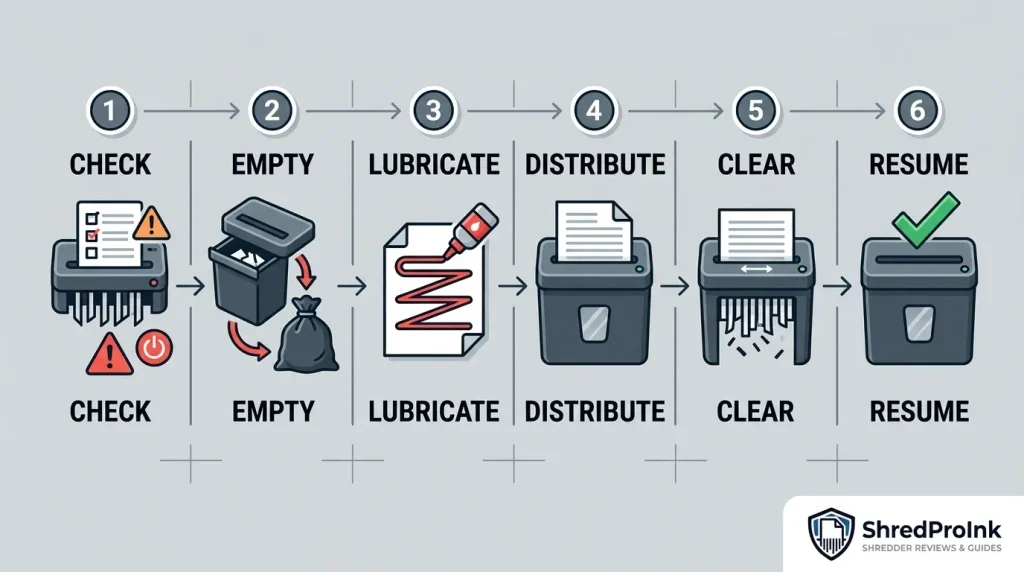
Empty
Empty the waste bin and make sure the machine isn’t already showing a full-bin or overheating condition.
Lubricate
Use the approved shredder oil or compatible lubricant sheet.
Distribute
Run the forward or reverse cycle specified for your model. Don’t copy another machine’s sequence.
Clear
Remove visible excess lubricant where the manual permits and keep the exterior and accessible areas clean.
Resume
Return to normal shredding while staying within the machine’s duty cycle.
This is ShredPro Ink’s editorial framework, not a proprietary engineering procedure. We built it to make manufacturer maintenance instructions easier to follow and compare.
A Simple Paper Shredder Maintenance Schedule
A good routine doesn’t need to become complicated.
| Maintenance task | Trigger |
|---|---|
| Empty bin | When full or before maintenance |
| Lubricate cutters | Manufacturer-recommended interval |
| Inspect feed opening | When performance changes |
| Clean accessible exterior and sensors | As needed |
| Check duty cycle | During heavy shredding |
| Troubleshoot recurring jams | When jams repeat |
| Consider replacement | When repair and ownership costs no longer make sense |
For broader ownership guidance, see our paper shredder maintenance and ownership guide.
Documented Maintenance Example: Fellowes LX10
A useful example comes from the Fellowes LX10 manual. Its maintenance instructions say cross-cut shredders require oil for peak performance and connect insufficient oiling with reduced sheet capacity and increased noise. The manual specifies turning the machine OFF, applying oil across the entry, and running reverse for 2 to 3 seconds.
This isn’t a ShredPro Ink hands-on case study. It’s a documented manufacturer example, which is the distinction we maintain until we have our own testing records.
That evidence-based approach matters because maintenance procedures can differ between models.
Recommended Shredder Oils and Lubricant Sheets
The right product depends on what your shredder manufacturer permits.
Fellowes Powershred Shredder Oil
Best for: Users who prefer bottled oil and own a compatible cross-cut or micro-cut shredder.
Why consider it: It comes in a squeeze bottle with an extended nozzle, making application across the feed area easier.
Trade-off: Bottled oil requires more careful application than a pre-lubricated sheet.
Fellowes Powershred Performance+ Lubricant Sheets
Best for: Home users and small offices that want simple, low-mess maintenance.
Why consider it: The sheet format provides a pre-lubricated maintenance method without manually dispensing bottled oil.
Trade-off: The cost per maintenance cycle can be higher than bottled oil.
Amazon Basics Lubricating Sheets
Best for: Users whose shredder manufacturer permits compatible lubricant sheets and who want a commonly available alternative.
Why consider it: Current marketplace data shows these sheets as a popular category option.
Trade-off: Compatibility should still be checked against your shredder’s instructions rather than assumed from the product listing.
Common Shredder Oiling Mistakes
Waiting Until the Shredder Starts Jamming
Don’t treat the first serious jam as your maintenance reminder. Regular maintenance is easier than trying to recover a machine that is already performing poorly.
Using the Wrong Lubricant
A lubricant that works for another machine isn’t automatically suitable for yours. Check the manual first.
Applying Too Much Oil
More lubricant doesn’t mean better lubrication. Follow the manufacturer’s application method.
Ignoring the Manufacturer’s Procedure
The forward/reverse sequence can vary by shredder design. Fellowes documentation itself shows different procedures for different models.
Forgetting the Duty Cycle
Oil doesn’t prevent overheating caused by excessive continuous use. Respect the manufacturer’s run-time and cooling requirements.
Treating Oil as a Fix for Every Jam
A jam can result from too many sheets, incorrect feeding, paper buildup, a full bin, overheating, or a mechanical problem.
If lubrication doesn’t solve the issue, stop repeating the same step and troubleshoot the actual cause.
When Oiling Isn’t Enough
Persistent Jams
If jams continue after proper maintenance, follow the troubleshooting path in our paper shredder jam repair guide.
Overheating
If the machine reaches its thermal limit, stop shredding and follow the cooling procedure. See what to do when a shredder overheats.
Blade Cleaning
Lubrication isn’t the same as cleaning. If residue or buildup is the problem, see how to clean shredder blades safely.
Replacement
If a machine repeatedly fails despite proper maintenance, compare the cost of repair, downtime, and replacement. Our broader maintenance and ownership guide covers the ownership decision.
Choose the Easier Maintenance Routine
If your shredder supports both methods, your choice is simple:
Prefer more control and lower cost per use? Choose bottled shredder oil.
Prefer a cleaner, simpler routine? Choose lubricant sheets.
If you haven’t bought a shredder yet, start with our paper shredder buying guide and match the machine to your workload before choosing its maintenance supplies.
Frequently Asked Questions
How Do You Oil a Paper Shredder?
Turn the machine OFF, apply manufacturer-approved shredder oil according to the manual, then run the specified forward or reverse cycle. Some models support lubricant sheets instead. The exact sequence varies by machine.
What Oil Should I Use for a Paper Shredder?
Use the oil specified or approved by the manufacturer. Purpose-made shredder oil is the safest general category, but compatibility matters more than the label.
Can You Use WD-40 on a Paper Shredder?
Don’t assume WD-40 is suitable for shredder cutters. Manufacturer guidance varies by product, and some manufacturers specifically warn against aerosol lubricants. Use the lubricant specified for your machine instead.
For the detailed question, see can you use WD-40 on a paper shredder?.
How Often Should I Oil My Paper Shredder?
It depends on the model and usage. Some manufacturers recommend oiling whenever the waste bin is emptied, while other machines specify a monthly or different interval.
Are Lubricant Sheets Better Than Shredder Oil?
Neither is automatically better. Bottled oil gives you more control, while lubricant sheets offer a cleaner and more convenient application.
Do Micro-Cut Shredders Need More Oil?
Not necessarily. Micro-cut machines should follow their own manufacturer’s maintenance schedule. Don’t create a more frequent schedule simply because the machine produces smaller particles.
Do Strip-Cut Shredders Need Lubrication?
Some strip-cut machines may require lubrication, but the correct interval and lubricant depend on the model. Check the manual rather than assuming that strip-cut machines need no maintenance.
Can Oiling Stop a Paper Shredder From Jamming?
Oiling can help when inadequate lubrication contributes to cutter friction or buildup, but it won’t fix every jam. Overfeeding, paper buildup, overheating, and mechanical problems can cause jams too.
What Are the Signs a Shredder Needs Oil?
Common warning signs can include louder operation, slower feeding, reduced sheet capacity, and more frequent jams. These symptoms don’t prove that oil is the only problem, so inspect the machine and check its manual.
Can You Over-Oil a Paper Shredder?
Yes, excessive lubricant can create mess and isn’t a substitute for following the manufacturer’s application instructions. Apply the amount and method specified for your machine.
Final Takeaway
Learning how to oil a paper shredder is simple once you stop treating every machine as identical.
Check the manual, empty the bin, use an approved lubricant, follow the correct forward or reverse cycle, and respect the shredder’s duty cycle. Bottled oil gives you more control, while lubricant sheets make routine maintenance easier.
Most importantly, oil should sit inside a larger maintenance routine. If the shredder keeps jamming, overheats, feeds slowly, or makes unusual noises after proper lubrication, investigate the underlying problem instead of adding more oil.
That simple approach gives you a better-maintained machine without turning routine ownership into a chore.