
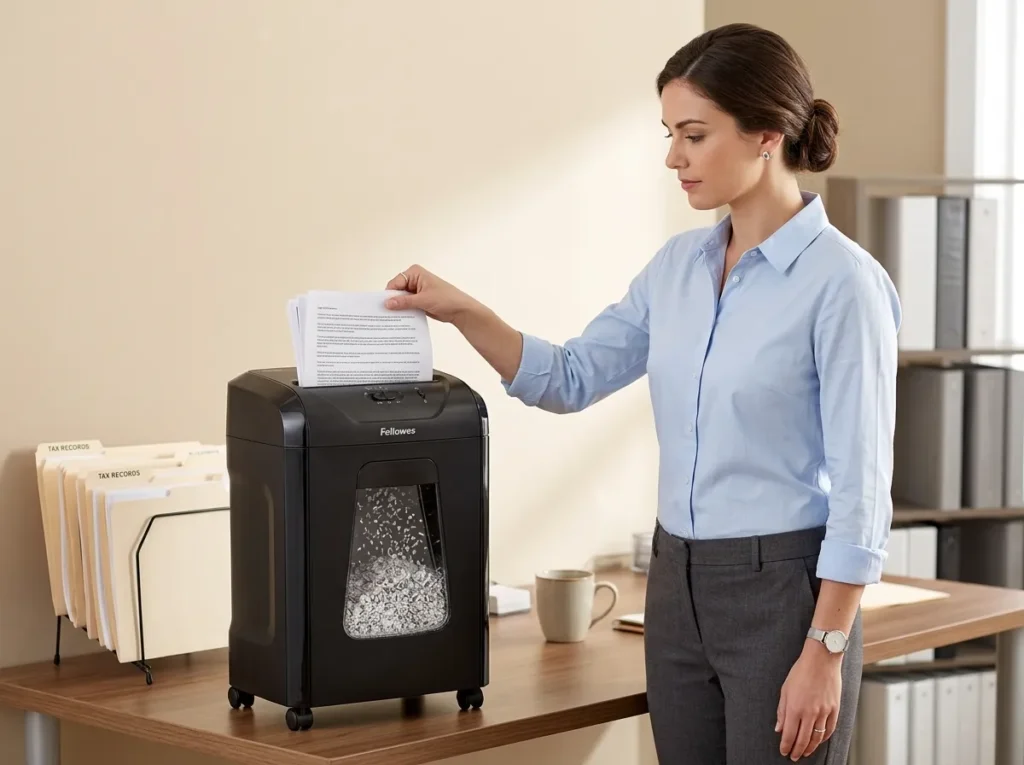
If you’re searching for the best micro cut shredder, don’t choose by the word “micro-cut” alone. Check the shredder’s security level, particle size, sheet capacity, run time, and cooling period first.
A micro-cut model can be a strong fit for bank statements, tax records, client paperwork, invoices, and other sensitive documents. Yet “micro-cut” does not automatically mean P-5. Current U.S. listings include micro-cut models rated P-4, while some Fellowes and Wolverine models reach P-5.
For this guide, we compared manufacturer specifications, security classifications, independent review information, verified-purchase feedback patterns, and current retailer data. We did not perform hands-on testing, so we won’t claim that we did.
Our six picks cover home-office security, value, P-5 protection, longer workloads, sub-$100 buying, and small-business use.
Affiliate Disclosure: As an Amazon Associate, ShredProInk earns from qualifying purchases. We may earn a commission if you buy through our links, at no extra cost to you.
Our 6 Best Micro-Cut Shredder Picks
These recommendations match different workloads rather than forcing one machine into every use case.
Fellowes Powershred LX200: Best Overall for Most Home Offices
Best for: Home-office users who want P-4 security, a 12-sheet rated capacity, and a reasonable continuous run time.
The Fellowes Powershred LX200 combines a P-4 security level with a rated capacity of up to 12 sheets per pass. Current product information lists a 10-minute maximum run time, a 15-minute cool-down period, a 6-gallon pull-out bin, and a 5/32 x 1/2-inch particle size.
Its SafeSense technology and automatic jam-handling features make it a practical choice for a shared home office. The 10-minute run window is long enough for routine paperwork, though a large tax-season backlog may call for something with a longer work cycle.
Verdict: A strong everyday choice when you want P-4 security without moving into a much larger office machine.
Pros
- P-4 security for sensitive personal and business paperwork
- 12-sheet capacity for routine office jobs
- 10-minute run time with a 15-minute cool-down
- 6-gallon pull-out bin
- SafeSense technology for added operating safety
Cons
- 15-minute cool-down can slow down larger jobs
- P-4 security may not suit buyers specifically requiring P-5
- Larger than some basic personal shredders
Staples 10-Sheet Micro-Cut Shredder ST62150: Best Value
Best for: Buyers who want P-4 micro-cut security without spending heavily.
The Staples ST62150 is rated P-4 and cuts paper into 4.3 x 13 mm particles. It accepts up to 10 sheets per pass, has a 5-gallon pull-out bin, and provides a 5-minute continuous run time followed by a 40-minute cool-down. Staples currently lists it at $73.99.
That short run time is the catch. This is a better fit for regular small batches than a major paperwork purge.
Verdict: A sensible lower-cost P-4 option when your shredding workload is light.
Pros
- P-4 security
- $73.99 current listed price at Staples
- 5-gallon bin
- Auto reverse and overload protection
- Handles paper, staples, clips, and credit cards
Cons
- 5-minute run time limits larger jobs
- 40-minute cool-down makes repeated batches slow
- 10-sheet capacity is modest
Wolverine SD9520: Best P-5 High-Security Pick
Best for: Buyers who specifically want a P-5 micro-cut shredder for highly confidential paperwork.
The Wolverine SD9520 is one of the clearest choices when P-5 is the deciding factor. Its published specifications list a 15-sheet capacity, 2 x 10 mm particle size, P-5 security, a 15-minute maximum continuous working time, an 8-gallon bin, and a rated noise level of 56 dB or less.
Independent Consumer Reports information gives the model additional context: its manufacturer claims P-5 security, while Consumer Reports reports its own measured shred size and evaluates security, speed, noise, and convenience.
The trade-off is physical size. At about 48 pounds with an 8-gallon bin, this is not the choice for someone who wants the smallest machine under a desk.
Verdict: Choose the SD9520 when P-5 security and a larger-capacity machine matter more than compact size.
Pros
- P-5 security
- 15-sheet capacity
- 2 x 10 mm particles
- 8-gallon waste bin
- 15-minute continuous working time
Cons
- 48-pound weight makes it less convenient to move
- Larger footprint than personal shredders
- P-5 may be unnecessary for ordinary household paperwork
Staples 150-Sheet Auto-Feed Micro-Cut Shredder ST62157: Best for Large Backlogs
Best for: Small offices and users facing large stacks of paperwork.
The Staples ST62157 changes the workload equation with a 150-sheet automatic feed. In manual mode, it accepts up to 12 sheets per pass. The unit is rated P-4, has a 30-minute continuous run time, a 40-minute cool-down, and a 7.4-gallon pull-out bin.
The key feature here isn’t the 150-sheet number by itself. It’s the ability to load a stack and let the automatic feed handle much of the work. That makes this a more natural fit for annual filing cleanup or small-office document disposal than a basic desk-side shredder.
Verdict: A practical choice when your problem is a large paper backlog rather than maximum P-level security.
Pros
- 150-sheet auto-feed capacity
- P-4 security
- 30-minute continuous run time
- 7.4-gallon bin
- Manual 12-sheet shredding mode
Cons
- 40-minute cool-down after the rated run period
- Larger footprint than personal models
- P-4 rather than P-5
Amazon Basics 12-Sheet Micro-Cut Shredder: Best for a Balanced Home Setup
Best for: Home users who want a 12-sheet P-4 shredder with a longer listed run time.
The Amazon Basics 12-Sheet Micro-Cut Shredder C218-D is listed with a 4 x 12 mm particle size, P-4 security, 12-sheet capacity, 20-minute continuous run time, 20-minute cool-down, and a 6-gallon pull-out bin.
That combination makes it interesting for people who shred more frequently than a basic personal unit but don’t need a P-5 machine.
The important limitation is that product specifications and availability can change, so verify the current Amazon listing before publishing a price or availability claim.
Verdict: A useful middle ground for routine home-office shredding where P-4 is sufficient.
Pros
- P-4 security
- 12-sheet capacity
- 20-minute listed run time
- 6-gallon bin
- Casters for mobility
Cons
- P-4 may not satisfy a P-5 requirement
- Product specifications should be rechecked before purchase
- Larger than compact personal models
Fellowes Powershred 450M: Best P-5 Pick for a Small Office
Best for: A home or small office that needs P-5 security but doesn’t need a large commercial shredder.
The Fellowes Powershred 450M is a P-5 micro-cut model with a listed capacity of up to 10 sheets and a run time of up to 10 minutes. Fellowes product information lists a 5-gallon waste bin, 5/64 x 1/2-inch particle size, and support for paper, staples, clips, credit cards, and optical media.
Its P-5 rating makes it a different proposition from the many P-4 models sold under the micro-cut label.
Verdict: A compact P-5 option for buyers who want finer particle destruction without moving to a large office machine.
Pros
- P-5 security
- Up to 10-sheet capacity
- Up to 10-minute run time
- 5-gallon pull-out bin
- Designed for home and small-office use
Cons
- Lower sheet capacity than some P-4 alternatives
- 10-minute run time limits large jobs
- P-5 costs more than many basic P-4 options
Quick Comparison: Best Micro-Cut Shredders at a Glance
The table focuses on the specifications that affect your buying decision. Prices change frequently, so treat price tiers as directional rather than fixed.
| Shredder | Security | Cut Size | Sheets | Runtime | Bin | Best For |
|---|---|---|---|---|---|---|
| Fellowes LX200 | P-4 | 5/32 x 1/2 in. | 12 | 10 min | 6 gal | Most home offices |
| Staples ST62150 | P-4 | 4.3 x 13 mm | 10 | 5 min | 5 gal | Lower-cost buying |
| Wolverine SD9520 | P-5 | 2 x 10 mm | 15 | 15 min | 8 gal | Higher security |
| Staples ST62157 | P-4 | 4.3 x 12 mm | 12 manual / 150 auto-feed | 30 min | 7.4 gal | Large backlogs |
| Amazon Basics C218-D | P-4 | 4 x 12 mm | 12 | 20 min | 6 gal | Routine home use |
| Fellowes 450M | P-5 | 5/64 x 1/2 in. | 10 | 10 min | 5 gal | Small-office P-5 |
How We Evaluate Micro-Cut Shredders
ShredPro Ink does not claim to have hands-on tested these models unless a documented testing program exists.
Our recommendations combine manufacturer specifications, DIN security information, independent reviews, verified-purchase feedback patterns, and current pricing and availability checks.
We focus on the specifications that change the buying decision:
- Security level: P-4 or P-5 where stated
- Particle size: smaller particles generally indicate a higher DIN security level
- Sheet capacity: the manufacturer’s stated maximum per pass
- Run time: how long the unit can operate before its specified break
- Cooling time: how long the machine needs before another work cycle
- Bin capacity: how frequently you’ll need to empty it
- Workflow features: auto-feed, auto-reverse, overload protection, and safety features
- Independent feedback: documented observations from established review sources and buyer feedback
- Current pricing: retailer information checked before publication
That distinction matters. A product page can tell you that a shredder is “jam-proof,” but that phrase describes a manufacturer’s marketing claim, not a guarantee that jams cannot happen.
For security standards, we rely on published DIN 66399 information rather than treating a product’s marketing label as its security classification.
What Does “Micro-Cut” Actually Mean?
Micro-cut describes how a shredder cuts paper into small particles. It is a physical cut description, not a single universal security rating.
That’s why two U.S. products can both be marketed as micro-cut yet carry different P-levels. For example, Staples lists its 10-sheet and 12-sheet micro-cut models as P-4, while the Fellowes 450M is listed as P-5.
The practical rule is simple:
Don’t buy a micro-cut shredder based on the label alone. Check the stated DIN security level and particle size.
Micro-Cut vs Cross-Cut
Cross-cut shredders cut paper into short strips or particles. Micro-cut shredders produce smaller particles, giving you a higher level of physical document destruction when the model carries an appropriate P-level.
Your choice should depend on the documents you’re destroying, not the name printed on the box.
If you’re comparing all three major cut styles, see our micro-cut vs cross-cut and strip-cut comparison.
P-4 vs P-5 Micro-Cut Security
DIN 66399 classifies paper under the P material category and defines seven security levels. P-4 allows a maximum regular particle area of 160 mm², while P-5 reduces that maximum to 30 mm².
That is a substantial difference in particle size.
| Level | Maximum Particle Area | Typical Security Context |
|---|---|---|
| P-3 | 320 mm² | Sensitive/confidential information |
| P-4 | 160 mm² | Particularly sensitive/confidential information |
| P-5 | 30 mm² | Information that needs to remain secret |
| P-6 | 10 mm² | Very high-security applications |
| P-7 | 5 mm² | Highest-security applications |
These categories describe security levels under the standard. They do not mean every household needs P-5.
For ordinary personal financial records, P-4 may be a reasonable fit. If your organization requires P-5, or your documents carry a higher confidentiality requirement, choose a shredder that explicitly states P-5 rather than assuming “micro-cut” is enough.
Why Particle Size Matters
Smaller particles leave less readable information in each piece and make reconstruction harder.
HSM’s current security guidance illustrates the difference: it lists P-4 at a maximum particle size of 160 mm² and P-5 at 30 mm².
That is why particle size belongs beside sheet capacity in your buying checklist.
A 15-sheet P-4 shredder is not automatically more secure than a 10-sheet P-5 machine. Capacity tells you how much paper you can feed at once. P-level and particle size tell you about the destruction level.
How to Choose a Micro-Cut Shredder
Start with the documents, then work down to the machine.
Start With Your Security Requirement
Ask what you’re actually destroying.
For bank statements, tax records, invoices, employee paperwork, or customer records, P-4 may fit many everyday confidential workloads. P-5 makes more sense when your organization requires that level or the information has a higher confidentiality requirement.
If you’re unsure, our understanding shredder security ratings guide gives you the broader P-level framework.
Check Sheet Capacity
A 12-sheet rating means the manufacturer rates the shredder for up to 12 sheets per pass under specified conditions.
It does not mean the machine can process 120 sheets as one workload without stopping.
Paper thickness, folded sheets, staples, and other materials can affect actual capacity.
Check Runtime and Cooling Time
Runtime matters more than many buyers expect.
A 12-sheet shredder with a 5-minute cycle can be slower for a large backlog than a 10-sheet machine with a longer work cycle.
This is where the Tax Season Prepper persona can make an expensive mistake: buying based on sheet capacity and discovering that the shredder spends more time cooling than shredding.
Don’t Ignore Bin Capacity
A larger bin means fewer interruptions.
For routine home use, 5 or 6 gallons may be manageable. For a small office or large paperwork purge, 7 or 8 gallons can reduce the number of emptying trips.
Look at Noise and Footprint
Home-office buyers should treat noise and size as functional specifications.
A shredder beside your desk can become annoying if every document batch interrupts calls or concentrated work. Check the manufacturer’s noise rating when one is available rather than relying on words such as “quiet.”
Check Anti-Jam and Thermal Protection
Automatic reverse, overload protection, temperature indicators, and thermal shutdown protection can reduce workflow interruptions.
Don’t treat “jam-proof” as a guarantee. Even Fellowes’ current product descriptions use that phrase as a named system or marketing claim, so it should not be converted into a promise that a machine can never jam.
For persistent jams after purchase, see our guide to common causes of paper jams.
Consider Auto-Feed for Large Backlogs
Auto-feed matters when you have a stack, not just a few pages.
The Staples ST62157, for example, accepts up to 150 sheets through its automatic feed and has a 30-minute continuous run time.
That makes the feature relevant for filing cleanup, small offices, and seasonal paperwork.
Are Micro-Cut Shredders Worth the Extra Cost?
For many buyers, yes, but the answer depends on your documents and workload.
If you shred sensitive financial or personal records regularly, the smaller particles produced by a suitable micro-cut model can justify spending more than a basic strip-cut machine.
The bigger question is whether you need P-4 or P-5.
You don’t need to buy the highest security level available just because it exists. If P-4 fits your document-security requirement, spending more on P-5 may give you less practical value than spending that money on a larger bin, longer runtime, or better workflow features.
For a small business, the calculation changes again. Downtime, cooling periods, and manual feeding can matter more than saving $30 on the initial purchase.
Do You Need P-4 or P-5?
Use this table as a starting point, then check your organization’s own security policy where one exists.
| Your Situation | Starting Point | Why |
|---|---|---|
| Household mail and routine personal paperwork | P-4 | Stronger destruction for sensitive documents |
| Tax returns and financial records | P-4 | DIN P-4 covers particularly sensitive/confidential paper |
| Client and employee records | P-4 or P-5 | Depends on the confidentiality requirement |
| Medical records | P-5 may be appropriate | Higher confidentiality can justify finer particles |
| Highly confidential business material | P-5 | Smaller maximum particle area |
| Organization-specific P-5 requirement | P-5 | Match the stated policy |
| Specialized high-security material | P-6/P-7 | Requires a much more specific security assessment |
A P-level does not make a shredder “HIPAA compliant” by itself. Healthcare document security depends on the broader destruction process and applicable requirements.
For compliance-specific decisions, consult your organization’s compliance officer or counsel.
Micro-Cut Shredder Mistakes to Avoid
The cheapest shredder can become the expensive choice if it doesn’t match your workload.
- Buying based only on “micro-cut.” Check P-level and particle size.
- Confusing sheet capacity with workload capacity. Twelve sheets per pass doesn’t tell you how long the machine can run.
- Ignoring cooling time. A short run cycle followed by a long cooldown can make a large job frustrating.
- Buying P-5 without a reason. Higher security is not automatically better value for every household.
- Using a low-duty-cycle machine for a large backlog. Tax-season cleanup needs runtime as much as sheet capacity.
- Treating “jam-proof” as a guarantee. Marketing language cannot remove normal operating limits.
- Ignoring the bin. A tiny bin can turn a simple shredding job into repeated interruptions.
Which Micro-Cut Shredder Fits Your Situation?
If you’re a home-office professional, start with the Fellowes LX200 when P-4 security, 12-sheet capacity, and a 10-minute run cycle fit your workload.
If you’re focused on price, the Staples ST62150 gives you P-4 security at a much lower current listed price, but its 5-minute run time makes it a poor match for large batches.
If P-5 is the requirement, look at the Wolverine SD9520 or Fellowes 450M rather than assuming every micro-cut model reaches P-5.
If you’re dealing with a large paper backlog, the Staples ST62157 deserves attention because its 150-sheet auto-feed and 30-minute run time address workload friction rather than simply adding a higher security label.
For a broader product search, compare our this year’s standout performers.
A Simple Workload Example
Imagine you have 300 sheets of old financial paperwork.
A 15-sheet shredder requires at least 20 full feed loads to process 300 sheets if every load reaches its rated capacity:
300 ÷ 15 = 20 loads
That calculation doesn’t tell you the final job time. Feed speed, paper thickness, interruptions, bin emptying, and cooling requirements all affect the real workflow.
That’s why runtime belongs in the buying decision beside sheet capacity.
Frequently Asked Questions
What Is a Micro-Cut Shredder?
A micro-cut shredder cuts paper into small particles rather than long strips. The term describes the cutting method, but it does not guarantee one specific DIN security level.
Is a Micro-Cut Shredder More Secure Than a Cross-Cut Shredder?
Generally, micro-cut models produce smaller particles than typical cross-cut models, but compare the actual particle size and stated P-level rather than relying on the cut-type name alone.
Is P-4 or P-5 Better for a Micro-Cut Shredder?
P-5 represents a higher DIN security level than P-4 because the permitted particle area is smaller. P-4 allows up to 160 mm², while P-5 allows up to 30 mm² for paper.
Are All Micro-Cut Shredders P-5?
No. Current U.S. listings show micro-cut models rated P-4, including several Staples and Fellowes models. Some models, such as the Wolverine SD9520 and Fellowes 450M, are listed as P-5.
What Security Level Should I Use for Tax Documents?
P-4 is a useful starting point for highly sensitive personal paperwork such as tax records. Your organization’s policy or specific document requirements may call for a different level.
Are Micro-Cut Shredders Worth the Extra Cost?
They can be, especially when you regularly destroy sensitive documents. The value depends on the security requirement, workload, runtime, bin size, and price difference rather than the word “micro-cut” alone.
What Is the Best Micro-Cut Shredder for a Home Office?
The Fellowes LX200 is a strong fit for many home offices when P-4 security and a 12-sheet capacity meet the workload. Buyers who specifically need P-5 should look at a P-5 model instead.
What Is the Best Micro-Cut Shredder for a Small Business?
A small business handling larger document volumes should look beyond sheet capacity. The Staples ST62157 is worth considering for its 150-sheet auto-feed and 30-minute run time, while a P-5 model may make more sense when the security requirement calls for it.
How Many Sheets Should a Micro-Cut Shredder Handle?
For routine home-office work, 10 to 12 sheets per pass can be enough. Larger workloads benefit from higher capacity, longer runtime, or automatic feeding.
How Long Should a Micro-Cut Shredder Run Continuously?
There is no single ideal runtime. Current models range from short 5-minute cycles to 30-minute cycles and beyond, so match the rated runtime and cool-down period to your workload.
Editorial Methodology & Author
ShredProInk researches paper shredders by comparing manufacturer specifications, security classifications, independent review information, verified-purchase feedback patterns, and current pricing and availability.
We don’t claim hands-on testing unless documented testing has actually taken place.
Author: Umer Hussain
Umer Hussain researches and writes ShredProInk’s paper shredder buying guides, cross-referencing manufacturer specifications, DIN 66399 security ratings, and verified buyer feedback to help readers match a shredder to their actual document-security needs. See our Editorial Methodology for how recommendations are built.
Compliance note: This article explains general document-security concepts. It does not certify your organization as compliant with HIPAA, GDPR, FACTA, or another regulation. Consult your compliance officer or counsel for organization-specific requirements.