
Affiliate disclosure: As an Amazon Associate, ShredPro Ink earns from qualifying purchases. We may earn a commission when you purchase through our links, at no extra cost to you.
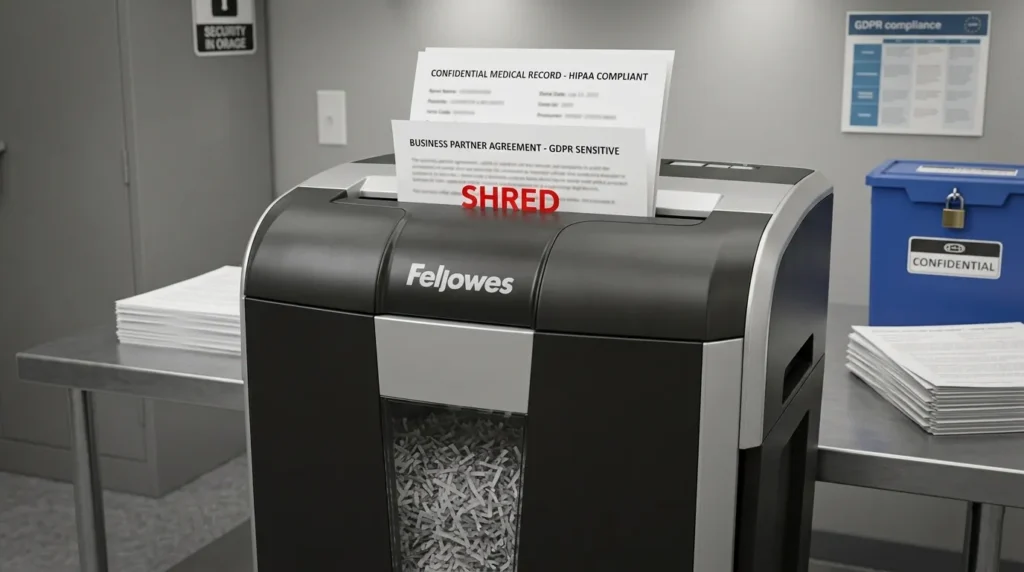
Choosing a HIPAA compliant shredder starts with understanding what the law requires, not a product label. HIPAA and GDPR do not establish one universal P-level for every paper document. Your organization needs a suitable destruction method, appropriate access controls, and a process that reflects its legal obligations and internal security policy.
For many offices handling routine confidential paperwork, a P-4 cross-cut shredder is a reasonable starting point to evaluate. A P-5 micro-cut model produces smaller particles and may suit stricter internal policies or higher-risk records. Neither rating, by itself, proves legal compliance.
This guide explains the relevant rules, compares five shredder options, and gives you a practical framework for choosing and documenting your document-destruction process.
Quick Answer: What Should a Compliance-Focused Office Look For?
Start by identifying the records you handle, the rules that apply to your organization, and how much paper you need to destroy. Then compare the shredder’s verified DIN 66399 security level, particle size, duty cycle, capacity, and access-control features.
| Office requirement | What to investigate |
|---|---|
| Routine confidential paperwork | P-4 cross-cut as a starting point |
| Sensitive records requiring finer particles | P-5 micro-cut, subject to policy |
| Higher-risk or specially restricted documents | P-6 or P-7 if the applicable standard or policy calls for it |
| Large daily workloads | Commercial equipment with an appropriate duty cycle |
| Irregular batches of old files | Automatic-feed capacity and realistic batch-processing time |
| Limited staff time | A secure destruction service with suitable controls and documentation |
The rule to remember: P-4 is a purchasing starting point, not a legal guarantee or certification.
For a broader technical explanation, see our DIN 66399 security-level guide. It explains how the destruction rating fits into a wider document-security decision.
What Does HIPAA Actually Require When Disposing of PHI?
Protected health information (PHI) is individually identifiable health information held or transmitted by a HIPAA-regulated covered entity or business associate. Paper appointment records, patient forms, billing statements, and printed reports may contain PHI.
The HIPAA Privacy Rule requires covered entities to apply appropriate administrative, technical, and physical safeguards to protect PHI, including during disposal. The relevant provision is 45 CFR §164.530(c). The US Department of Health and Human Services (HHS) explains that safeguards must protect PHI against inappropriate uses and disclosures during the disposal process.
See the official HHS guidance on disposing of protected health information.
HIPAA Rules for Paper Records
HIPAA does not prescribe one universal paper-shredder P-level. Instead, the organization must choose and apply safeguards appropriate to its circumstances.
A medical practice disposing of appointment paperwork containing patient names and diagnoses should consider:
- Access before destruction: Keep records in a controlled area or secured container until authorized staff destroy them.
- Disposal method: Use a method appropriate to the sensitivity of the information and the risk of unauthorized access.
- Staff procedures: Define who may collect, transport, and destroy records.
- Third-party handling: Assess any outside destruction provider and the protections used throughout the process.
- Retention requirements: Confirm that records are eligible for destruction before disposing of them.
A shredder can form part of this process. Buying a machine with a P-4 or P-5 label does not replace policies, staff training, or appropriate safeguards.
What 45 CFR §164.310(d)(2)(i) Actually Covers
This Security Rule provision addresses the final disposition of electronic PHI and the hardware or electronic media on which it is stored. It also addresses removing electronic PHI from electronic media before reuse.
It is not a paper-shredder specification. Do not cite it as proof that HIPAA requires P-4 or P-5 shredding.
Paper records still need appropriate safeguards under the Privacy Rule. Electronic media require separate consideration because destroying a printed page does not erase information stored on a computer, drive, or other electronic device.
What Does GDPR Say About Document Destruction?
The General Data Protection Regulation (GDPR) can apply to personal data held in paper filing systems when those records form part of, or are intended to form part of, a filing system.
A GDPR document shredder is therefore best understood as equipment that may support an organization’s secure-disposal process, not a product category that automatically grants compliance.
Three provisions help explain the decision.
Article 5: Storage Limitation and Confidentiality
Article 5(1)(e) establishes the storage-limitation principle: personal data should not be kept longer than necessary for the purposes for which it is processed, subject to applicable exceptions.
Article 5(1)(f) addresses integrity and confidentiality, requiring appropriate protection against unauthorized or unlawful processing and accidental loss, destruction, or damage.
Together, these principles affect both when records should be destroyed and how they should be protected. An organization should not shred records prematurely if a legal retention obligation or another valid requirement calls for keeping them.
Article 32 and Appropriate Security Measures
Article 32 requires controllers and processors to implement technical and organizational measures appropriate to the risk. The assessment takes account of factors such as the nature of the processing and the potential impact on individuals.
The regulation does not specify a universal P-4 or P-5 paper-shredder requirement. A data controller must assess its obligations and risks; a data processor must meet the duties applicable to its role and arrangements.
For example, a small EU business disposing of expired customer paperwork should first check its retention policy. It should then select a destruction method that protects personal data throughout collection, storage, transport, and disposal.
Read the official GDPR text on EUR-Lex. Articles 5 and 32 provide the relevant legal context.
Is P-4 the Minimum for HIPAA or GDPR?
No. Neither HIPAA nor GDPR establishes a universal P-4 or P-5 minimum for every paper record.
DIN 66399 is a document-destruction security standard that classifies the destruction of different media. For paper, the P-level describes the technical security category associated with the size of the resulting particles. The rating helps buyers compare equipment, but it does not determine every legal obligation an organization has.
P-4 vs. P-5 for Medical Records
P-4 cross-cut shredders turn paper into small particles. P-5 micro-cut shredders produce finer particles. The choice should reflect the organization’s documented risk assessment, applicable requirements, and operational needs.
| Level | Technical distinction | When to investigate it |
|---|---|---|
| P-4 | Cross-cut, with particles up to the category’s specified maximum dimensions | Routine confidential paperwork when the organization’s policy supports this level |
| P-5 | Finer micro-cut particles than P-4 | Sensitive records or policies requiring greater particle reduction |
| P-6 | Higher security with finer particles than P-5 | Stricter security requirements or a relevant technical standard |
| P-7 | Very high paper-destruction security | Specific high-security requirements that call for this category |
Check the exact DIN rating and particle dimensions in the manufacturer’s documentation before buying. Cut labels such as “micro-cut” are not enough to confirm a particular P-level.
When a Higher Security Level Makes Sense
A higher rating may be appropriate when an organization’s policy, contract, risk assessment, or applicable standard requires it. However, finer particles can come with practical trade-offs, including slower processing, lower sheet capacity, more frequent bin emptying, or a higher purchase price.
Do not automatically buy P-5 simply because a document contains health information. Equally, do not assume P-4 is adequate without checking the requirements that apply to your organization.
Our document-security pillar explains how security ratings fit into the broader destruction process. For a narrower decision, see P-5 security for medical records.
Five Shredders to Consider for Compliance-Focused Offices
The following options cover smaller offices, automatic-feed workloads, and high-volume departments. They are equipment candidates, not certified compliance products.
The specifications below are drawn from manufacturer or product documentation surfaced during research. Confirm the exact US model, current listing, price, warranty, and affiliate availability before publishing purchase links. We do not claim hands-on testing.
1. Fellowes Powershred LX221: P-5 for Small Offices
The Fellowes Powershred LX221 is a micro-cut shredder worth considering for a small office that needs finer particle destruction without buying a large departmental machine.
Published specifications list a P-5 security level, 2 × 12 mm particles, up to 20 sheets per pass, a 25-minute maximum run time, and a 30-liter pull-out bin. Confirm the current US model’s specifications and warranty before relying on these figures.
Best for: A small medical or professional office with a moderate volume of confidential paper and a policy that supports P-5.
Pros
- P-5 micro-cut classification in published specifications.
- Up to 20 sheets per pass in the cited documentation.
- Pull-out bin for easier emptying.
- Safety and jam-management features.
Cons
- Not intended to replace a high-volume departmental shredder.
- Requires downtime after its rated operating period.
Verdict: A practical candidate for small-office workflows, provided its current specifications and capacity match your needs.
2. Aurora AU200MA: Automatic Feeding for Routine Batches
The Aurora AU200MA combines automatic feeding with P-5 micro-cut destruction. Its manufacturer lists automatic feeding for up to 200 sheets, manual feeding for up to 10 sheets, a 60-minute continuous run time, a 2 × 12 mm particle size, and an 8.5-gallon bin.
Those features may suit an office that periodically destroys a stack of confidential paperwork instead of feeding every page by hand.
Best for: Small offices that need automatic batch processing and a P-5 rating.
Pros
- Up to 200 sheets through automatic feed.
- P-5 micro-cut classification.
- Published 60-minute continuous run time.
- Pull-out waste bin.
Cons
- Requires enough floor or desk space for its footprint.
- Automatic-feed capacity does not remove the need to control access to documents before and during destruction.
Verdict: A useful candidate for batch work, provided the current US listing confirms the model and specifications.
3. Fellowes AutoMax 200M: Walk-Away Batch Shredding
The Fellowes AutoMax 200M is a more accurate model to investigate than the AutoMax 150M named in the initial shortlist. Fellowes’ product materials list the 200M as a P-5 micro-cut model with automatic feeding for up to 200 sheets, manual feeding for up to 10 sheets, an 8.5-gallon bin, and a rated run time of around 25 minutes.
Automatic feeding can reduce the time staff spend feeding pages individually. It does not remove the need to monitor the process, secure the feed tray where appropriate, or confirm that all records have been destroyed.
Best for: Small practices with recurring batches that fit the machine’s capacity and operating cycle.
Pros
- Automatic and manual feeding.
- P-5 micro-cut classification.
- Published 200-sheet automatic-feed capacity.
- Bin capacity suited to small-office use.
Cons
- Not a substitute for continuous high-volume equipment.
- A full tray can still require time to process, so match capacity to your actual workload.
Verdict: A candidate for offices that want automatic feeding without moving to large commercial equipment.
4. GBC 600M Office AutoFeed+: High-Volume P-5 Processing
The GBC 600M Office AutoFeed+ is aimed at larger workloads. Its product documentation lists P-5 micro-cut destruction, automatic feeding for up to 600 sheets, manual feeding for up to 10 sheets, a 29-gallon bin, and a continuous run time of up to 240 minutes.
That combination makes it worth evaluating for a shared office or department that regularly handles substantial volumes of confidential paper.
Best for: Higher-volume offices that can justify a large commercial machine.
Pros
- Up to 600 sheets through automatic feeding.
- P-5 micro-cut classification.
- Large 29-gallon bin.
- Published run time of up to 240 minutes.
Cons
- Takes considerably more space than a small-office shredder.
- Purchase and operating costs may be excessive for a low-volume practice.
Verdict: The strongest candidate on this list for sustained batch processing, if its current price, warranty, and throughput fit your budget.
5. Fellowes AutoMax 600M: Commercial Automatic Feeding
The Fellowes AutoMax 600M is another commercial model to investigate for larger departments. Fellowes’ AutoMax range documentation lists a 600-sheet automatic-feed capacity, a 14-sheet manual-feed capacity, micro-cut destruction, a 22-gallon bin, and a design intended for commercial or shared use.
Check the exact model number and current US product documentation before comparing it directly with the GBC 600M. The two products differ in published bin capacity and other specifications, so they should not be treated as identical.
Best for: A department that needs automatic batch processing and a commercial-use design.
Pros
- Published 600-sheet automatic-feed capacity.
- Manual-feed option for smaller jobs.
- Micro-cut model in the commercial range.
- Intended for shared office workflows.
Cons
- A large purchase for a small practice with occasional paperwork.
- Confirm the precise DIN rating, run-time terms, warranty, and current US availability before purchase.
Verdict: A commercial alternative worth comparing against the GBC 600M, particularly if your office already uses Fellowes equipment.
Product Comparison: Match Security to Workload
Use this table as a shortlist, not a final compliance ranking. Manufacturer specifications can change, and the best choice depends on your organization’s policy.
| Model | Security | Feed capacity | Published run time | Best fit |
|---|---|---|---|---|
| Fellowes LX221 | P-5 | Up to 20 sheets manually | Up to 25 minutes | Small office |
| Aurora AU200MA | P-5 | 200 auto / 10 manual | Up to 60 minutes | Routine batches |
| Fellowes AutoMax 200M | P-5 | 200 auto / 10 manual | Around 25 minutes | Small-office batch work |
| GBC 600M Office AutoFeed+ | P-5 | 600 auto / 10 manual | Up to 240 minutes | High-volume department |
| Fellowes AutoMax 600M | Micro-cut; verify exact DIN rating | 600 auto / 14 manual | Verify current model documentation | Commercial shared use |
In-House Shredding vs. a Professional Destruction Service
An office shredder is not always the best choice. A professional destruction service may suit organizations that generate large volumes of records, lack secure storage space, or cannot spare staff time for routine shredding.
| Factor | In-house shredder | Professional service |
|---|---|---|
| Initial cost | Equipment purchase | Usually a service contract or per-visit charge |
| Staff time | Staff operate and maintain equipment | Less time spent feeding documents |
| Access control | Office manages the entire workflow | Provider controls must be assessed |
| High-volume work | Depends on capacity and duty cycle | May suit large recurring batches |
| Documentation | Office maintains its own records | Provider may supply service records or a certificate |
| Operational control | Direct control over equipment and timing | Depends on provider procedures and contract |
A certificate of destruction can document a service event, but it does not automatically prove legal compliance. Evaluate the provider’s security procedures, personnel access, transport arrangements, contract terms, and documentation practices.
For regulated records, the organization remains responsible for evaluating its own obligations. Do not assume that outsourcing transfers every compliance duty to the service provider.
How to Choose a HIPAA-Compliant Shredder
Use this process to make a defensible purchasing decision. The objective is to select suitable equipment within a secure document-destruction program, not to purchase a machine and assume the work is done.
1. Identify the Records and Their Sensitivity
List the documents your office handles, such as patient forms, billing records, contracts, bank statements, or customer files. Identify the information they contain and the rules or contracts that govern their handling.
2. Confirm Retention and Destruction Policies
Check when each record may be destroyed. A shredder cannot resolve a retention conflict, and a document should not be destroyed merely because it has become inconvenient to store.
3. Select the P-Level
Use your documented risk assessment, applicable rules, contracts, and internal policy to determine the required security level. Compare the manufacturer’s DIN rating and particle dimensions, rather than relying on terms such as “high security” alone.
4. Calculate Workload and Duty Cycle
A shredder’s duty cycle describes how long it can operate before it needs a break. Compare your daily volume and peak batches with the machine’s rated run time, feed capacity, cooldown period, and bin size.
5. Restrict Access to Records Awaiting Destruction
Store pending documents in a controlled location or suitable secure container. Limit access to authorized staff and account for records during any transfer to a destruction provider.
6. Establish a Repeatable Procedure
Write down who approves disposal, who operates the machine or arranges collection, how staff handle interruptions, and what happens when a shredder jams. Staff should follow the manufacturer’s instructions rather than force paper into the cutters.
A paper shredder jam can delay disposal and expose records if staff leave documents unattended. Train employees to secure the remaining paperwork, disconnect or isolate equipment as directed by the manufacturer, and clear the jam only according to the manual.
7. Keep Appropriate Records
Maintain destruction logs or service records when required by your policy, contract, or applicable obligations. Record the information necessary to demonstrate that the process was followed, without creating another unnecessary repository of sensitive personal data.
Document Destruction Checklist for Medical and Small Business Offices
Before approving a shredder purchase or destruction contract, confirm each item:
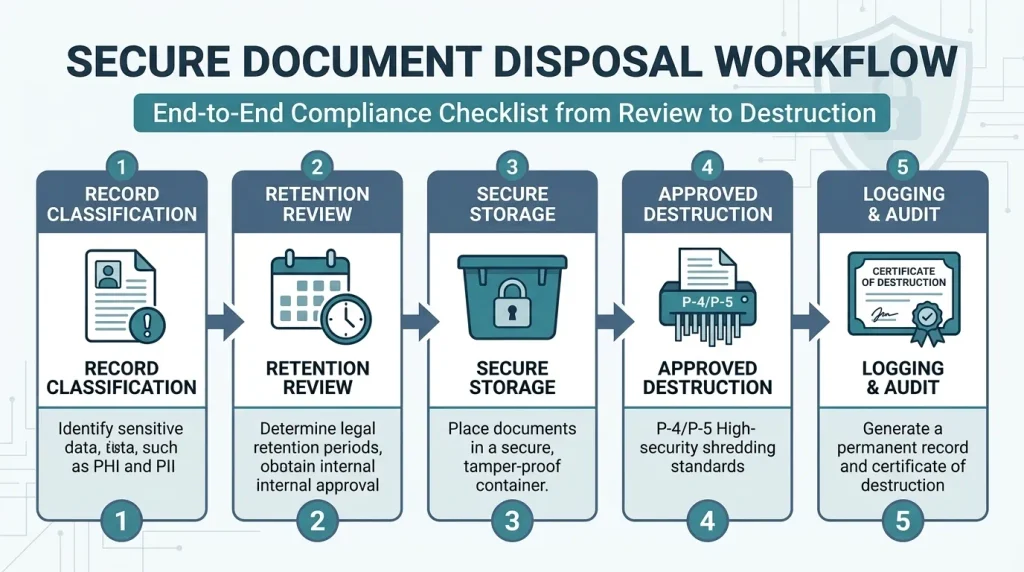
- The organization has identified the records and their sensitivity.
- The applicable retention period has ended or destruction is otherwise authorized.
- The selected security level matches the documented policy and risk assessment.
- The machine’s capacity, duty cycle, bin size, and maintenance needs match the workload.
- Staff can restrict access to records awaiting destruction.
- The organization has a written procedure for in-house or outsourced destruction.
- Staff know how to handle a jam or equipment failure without leaving records exposed.
- Required destruction logs, service records, or other evidence are retained appropriately.
- Product specifications, warranty terms, and availability have been verified.
- The compliance officer or legal adviser has reviewed any unresolved regulatory questions.
Frequently Asked Questions
Does HIPAA Require a P-4 Shredder?
No. HIPAA does not prescribe a universal P-4 paper-shredder requirement. The Privacy Rule requires appropriate safeguards for PHI, including during disposal. Select a destruction method that fits your organization’s obligations and risk assessment.
For the detailed explanation, read our guide to what HIPAA requires for paper disposal.
Is P-5 Better Than P-4 for Medical Records?
P-5 produces finer particles than P-4. It may be appropriate when an organization’s policy or risk assessment calls for finer destruction, but the higher rating alone does not establish compliance.
Does GDPR Require a Specific Shredder Security Level?
No universal P-4 or P-5 requirement appears in GDPR. Articles 5 and 32 address data-handling principles and appropriate security measures. The organization must determine a suitable approach for its records and circumstances.
Use our GDPR document destruction checklist to review the operational steps.
What Makes a Shredder Suitable for Confidential Business Records?
Check the verified DIN security level, particle dimensions, workload capacity, run time, bin size, and supported materials. Then assess whether the equipment fits the organization’s wider access-control and disposal procedures.
Is There an Officially HIPAA-Certified Paper Shredder?
Do not assume that a P-level or a seller’s marketing claim represents official HIPAA certification. Verify any specific certification claim independently. A technical security rating describes the machine’s destruction category, not the organization’s legal compliance.
Does a Certificate of Destruction Prove Compliance?
No. It may provide evidence that a service provider completed a destruction job, but it does not by itself prove that the organization followed every applicable requirement. Review the provider, contract, chain of custody, and internal procedures.
Should a Small Medical Practice Shred Documents In-House?
It can, if suitable equipment, secure storage, staff procedures, and maintenance are practical for the practice. Outsourcing may make more sense when volume, staff time, or secure handling requirements exceed the office’s capabilities.
How Should a Business Document Its Destruction Process?
Maintain a written policy, assign responsibility, control access to pending records, and retain the logs or service records required by the organization’s policy and applicable rules. Keep documentation proportionate to the process and protect any sensitive information it contains.
Final Recommendation: Choose the Process Before the Product
A HIPAA compliant shredder is not a special legal category that a product earns simply by displaying P-4 or P-5. The right purchase supports a wider process that protects records before, during, and after destruction.
For a small office considering finer paper destruction, start by comparing the Fellowes LX221, Aurora AU200MA, and Fellowes AutoMax 200M. For a department with sustained batch workloads, compare the GBC 600M Office AutoFeed+ with the Fellowes AutoMax 600M. Verify the exact model, current specifications, and price before making a purchase.
If you still need to choose a security rating, read our DIN 66399 guide. If you need to confirm the policy behind the purchase, consult our HIPAA paper-disposal guide, GDPR destruction checklist, and P-5 medical-records guide.
Legal disclaimer: This article provides general educational information, not legal advice or a certification of compliance. Consult your organization’s compliance officer or legal counsel to confirm the requirements that apply to your records and destruction process.
Editorial Methodology
ShredPro Ink compares manufacturer specifications, published security ratings, product documentation, independent reviews, and verified-purchase feedback where available. Product details and availability should be checked again before publication and during content updates. We do not claim hands-on testing unless the specific testing has taken place.
See our Editorial Methodology for how we evaluate paper shredders and make recommendations.
Author
ShredPro Ink Editorial Team
The ShredPro Ink editorial team researches paper shredder buying guides by cross-referencing manufacturer specifications, DIN 66399 security ratings, and buyer feedback to help readers match equipment to their document-security needs. For compliance questions specific to your organization, consult your compliance officer or legal counsel.