

If you’re wondering when should you shred tax documents, three years is the usual federal starting point, but it isn’t a universal rule. The IRS ties record retention to the applicable period of limitations, and some situations require you to keep tax records for six years, seven years, or indefinitely.
Before you put an old tax folder through a paper shredder, check what the records support, when the return was filed, and whether an exception applies.
Quick answer: Most taxpayers should keep federal tax returns and supporting records for at least three years. Some records need to stay longer because of unreported income, refund claims, bad debts, worthless securities, property transactions, or other circumstances.
When Can You Safely Shred Tax Documents?
The usual federal rule is three years for records supporting a filed income tax return, assuming none of the longer-retention situations applies. The IRS calls this the period of limitations, meaning the time in which you can amend a return to claim a credit or refund or the IRS can assess additional tax.
For this purpose, the IRS says returns filed before their due date are treated as filed on the due date. That means the calendar date printed on an old folder is less useful than knowing when the applicable tax return was filed and what situation applies to it.
The practical rule is simple: don’t shred a tax record just because it looks old. First identify what it supports, then check the applicable retention period.
How Long Should You Keep Tax Records?
Use this table as a federal starting point. It applies to common income-tax situations, not every possible tax or legal record.
| Tax situation | General federal retention period |
|---|---|
| Filed return with no special exception | 3 years |
| Refund or credit claim filed after the return | Later of 3 years from filing or 2 years after tax was paid |
| More than 25% of gross income omitted | 6 years |
| Worthless securities or bad debt deduction | 7 years |
| Fraudulent return | No limit |
| No return filed | No limit |
| Records connected to property | Keep until the applicable period ends after disposition |
The IRS says the period is measured according to the circumstances surrounding the return. Property records can require much longer storage because you may need them to establish basis, depreciation, or gain when the property is sold or otherwise disposed of.
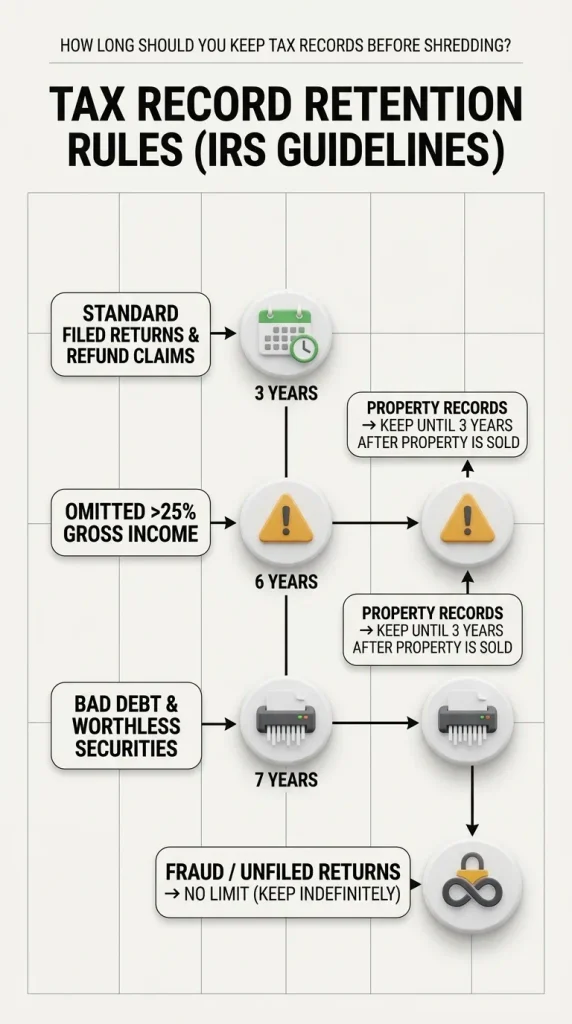
This is why how long to keep tax records before shredding cannot be answered with one number for every taxpayer.
Does April 15 Determine When You Can Shred Tax Records?
No. April 15 is not a universal shredding date.
The relevant retention period depends on the return and the applicable period of limitations. The IRS states that returns filed before their due date are treated as filed on the due date when calculating these periods.
For example, imagine a taxpayer files a federal return before the normal filing deadline and has no special retention exception. The three-year period starts from the date the IRS treats that return as filed, not from an arbitrary date chosen for a paper-cleanout.
That distinction matters if you’re clearing several years of tax paperwork at once. Check each tax year instead of putting every old folder into the shredder based on its age.
Which Tax Documents Can You Shred Once the Period Ends?
Once the applicable retention period has expired and no other reason requires you to keep the record, common supporting documents may become candidates for secure destruction.
These can include:
- Tax returns and schedules you no longer need for tax or other recordkeeping purposes.
- Form W-2 and Form 1099 records that support income reported on the return.
- Receipts and canceled checks supporting deductions, credits, or payments.
- Supporting documentation used to substantiate items reported on the return.
- Other tax-related paperwork that has no remaining tax, legal, insurance, or financial purpose.
The IRS says taxpayers should keep copies of filed tax returns because they can help with future returns, amended returns, and audits. Digital copies can reduce the amount of paper you need to store, but keep them accessible and protected before destroying the physical originals.
The FTC’s current consumer guidance likewise lists income tax returns and tax-related records among documents that should be kept for at least three years, with longer retention in some situations.
When Should You Keep Tax Records Longer?
The three-year rule stops being enough when your tax situation falls into an IRS exception or another legitimate retention need exists.
Keep records longer when:
- You omitted more than 25% of gross income. The IRS lists a six-year period in this situation.
- You claimed a bad debt or worthless securities loss. The applicable period is seven years.
- You filed a fraudulent return. The IRS lists no limitation period.
- You did not file a return. The IRS lists no limitation period.
- The records relate to property or investments. Keep them through the applicable period after the property is disposed of.
- Another organization needs the records. The IRS advises checking non-tax requirements, such as requirements from an insurer or creditor, before destroying records.
- A tax dispute or other unresolved matter exists. Don’t destroy documents that may still support an open matter.
State tax records can follow different rules from federal records. If you’re dealing with state income taxes, check the applicable state requirements before shredding a document simply because the federal retention period has ended.
A Worked Example: An Old Tax Folder
Example only, not a real customer case study: Suppose you have a federal tax folder containing a return, W-2s, 1099s, deduction receipts, and canceled checks.
If the return falls under the ordinary three-year federal period, no special exception applies, the records aren’t tied to property, and no other retention requirement exists, those records may become candidates for secure destruction once the applicable period has expired.
If the folder contains property records, a large omitted-income issue, or documentation for a bad-debt or worthless-securities claim, the answer changes.
The lesson is simple: sort tax records by purpose before you sort them by age.
How to Shred Old Tax Documents Safely
Once you’ve confirmed that a tax record no longer needs to be retained, don’t put intact paperwork in the trash. Tax records can contain names, addresses, Social Security numbers, account information, income details, and other personal or financial information.
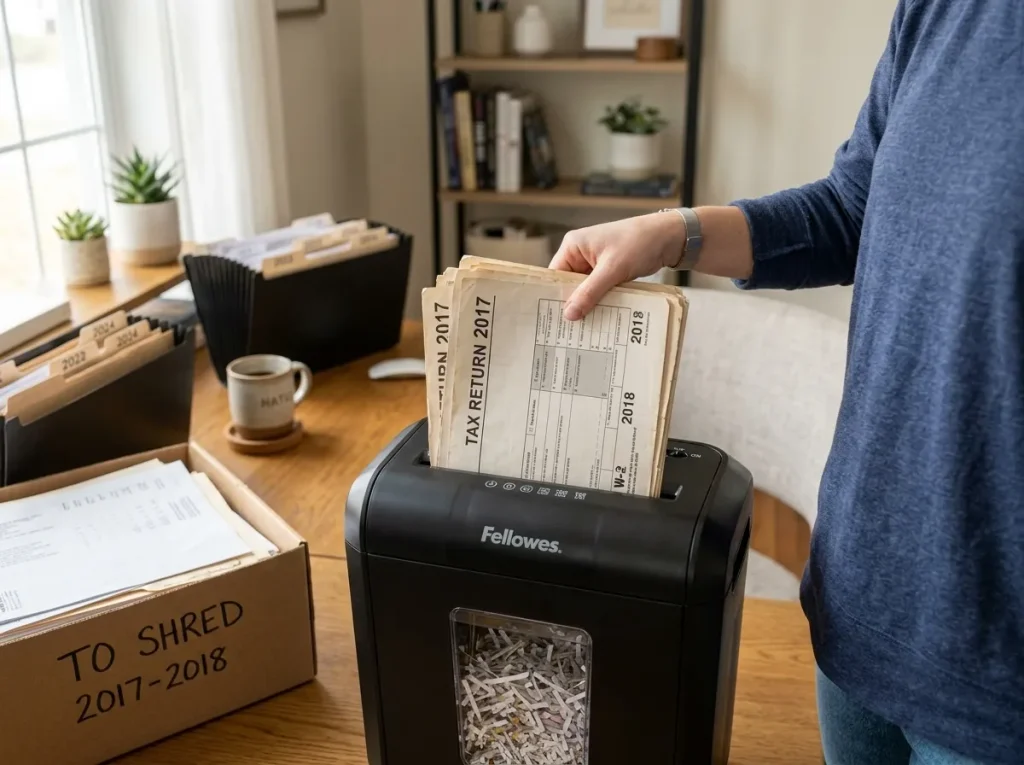
The FTC recommends shredding documents containing personal or financial information before disposal.
For a home tax purge:
- Separate documents that still need to be kept.
- Remove folders, clips, and other materials according to your shredder’s instructions.
- Use a cross-cut or micro-cut paper shredder for sensitive financial paperwork.
- Work in batches that match the shredder’s capacity and run time.
- Secure the shredded material for disposal according to your local recycling or waste rules.
If you want the full disposal process, see our guide to shredding financial records safely. For the wider privacy side of document destruction, see our document security guide.
Ready to Shred? Choose a Tax-Season Shredder
If you’ve finished the retention check and have a large tax-document pile ready to destroy, the next question is equipment.
A small annual purge has different needs from a 500-page filing backlog. Compare cut type, sheet capacity, bin size, and run time before choosing a machine.
See our tax-season shredder recommendations for models suited to tax paperwork and larger seasonal cleanouts.
Frequently Asked Questions
Can I Shred Tax Returns After 3 Years?
Often, yes, if the normal three-year federal retention period applies and no exception or other retention requirement applies. Check the record’s purpose before shredding.
Is It Safe to Shred Tax Documents After April 15?
Not automatically. April 15 does not create a universal shredding date. The applicable period of limitations and the circumstances surrounding the return determine how long supporting records should remain available.
How Long Should I Keep W-2s?
W-2s that support a federal tax return are generally retained with the related tax records for the applicable retention period. The FTC lists W-2s among tax-related records to keep for at least three years, with longer retention possible in certain situations.
How Long Should I Keep 1099s?
Keep Form 1099 records with the tax return and supporting documentation they relate to for the applicable retention period. Don’t use the age of the form alone to decide when to destroy it.
Do I Need to Keep Receipts After Filing Taxes?
If a receipt supports income, a deduction, or a credit, keep it for the applicable retention period. Receipts tied to property may need to stay longer.
What Tax Records Should I Keep for 7 Years?
The IRS lists seven years for records connected to a claim for a loss from worthless securities or a bad-debt deduction.
What Tax Records Should Never Be Shredded?
Don’t assume any tax document must be kept forever. Instead, identify records with continuing tax, property, legal, financial, or personal value before destroying them.
Should I Shred Old Tax Documents or Throw Them Away?
Shred tax documents that contain personal or financial information once you’re legally and practically finished with them. The FTC recommends shredding sensitive documents before disposal rather than putting readable information into ordinary trash.
Source Note
Tax-retention rules can depend on your filing situation and the type of record. This article summarizes general federal guidance and is not individualized tax or legal advice. Check current federal and state requirements before destroying records tied to property, disputes, unusual tax situations, or other unresolved matters.
Last reviewed: October 2026