
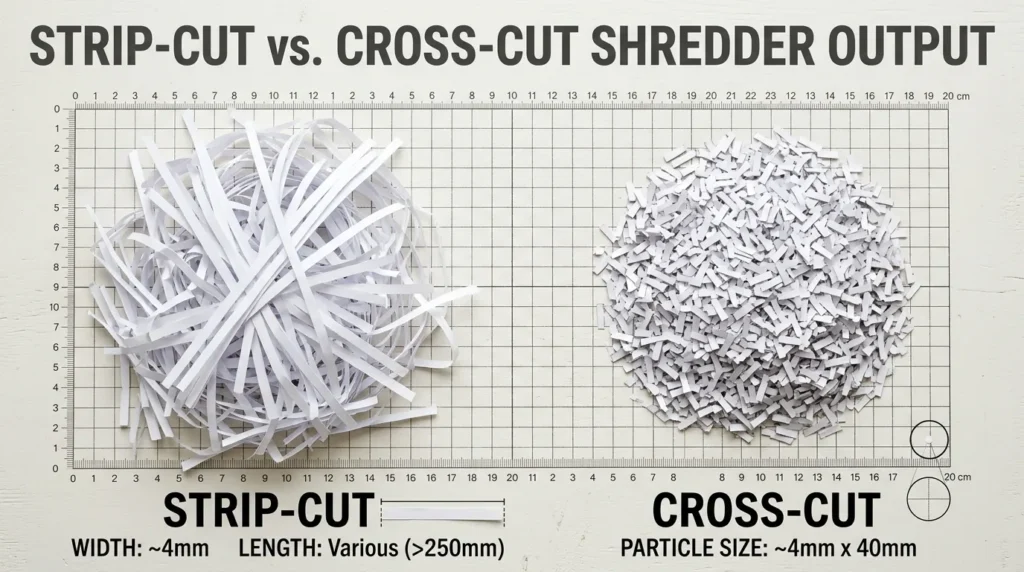
A strip-cut shredder cuts paper into long, narrow strips. It can be a sensible budget purchase for non-confidential paper, but it is a poor choice for documents containing financial details, personal identifiers, or private business information. The main trade-off is simple: lower upfront cost versus weaker document security.
What Is a Strip-Cut Shredder?
A strip-cut shredder, sometimes called a ribbon-cut shredder, uses rotating cutters to slice paper into long, narrow strips. Unlike cross-cut machines, it does not cut across the strips to create smaller particles.
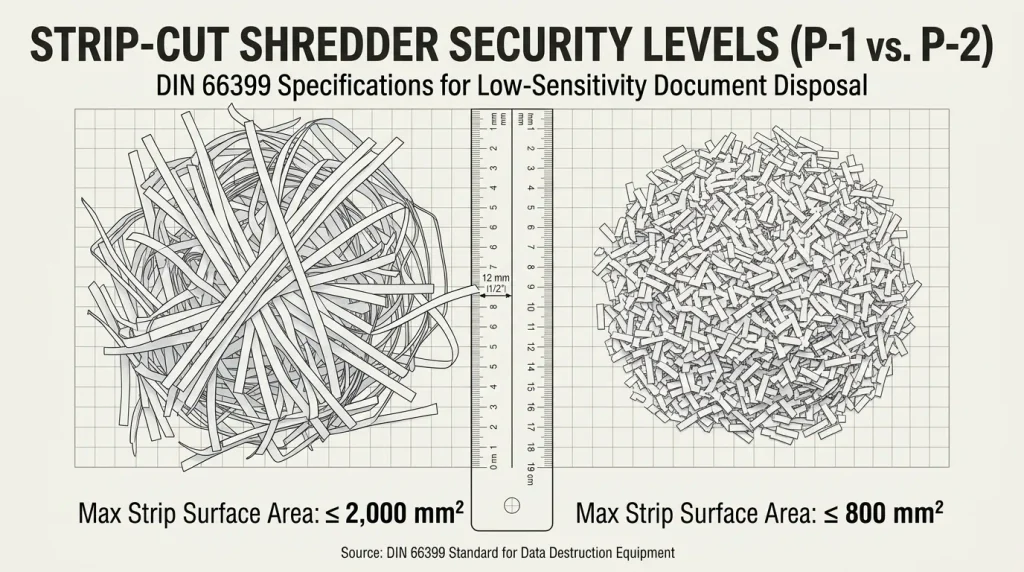
Under DIN 66399, the German standard for secure data destruction, strip-cut machines commonly fall into P-1 or P-2, depending on their documented particle specifications. These are basic security levels intended for low-sensitivity material. Check the exact rating on the model you plan to buy. Fellowes’ security-level guide explains the relationship between cut type and security rating.
For a broader look at the differences, read our guide to choosing between strip-cut, cross-cut, and micro-cut shredders.
Pros of Strip-Cut Shredders
Lower Upfront Cost
Entry-level strip-cut machines can appeal to buyers who want basic paper destruction without paying for finer cutting mechanisms. However, prices vary by brand, features, and machine size. A strip-cut model is not automatically cheaper than every cross-cut alternative.
Fast Handling of Suitable Paper
Strip-cut shredders can process batches of non-confidential paperwork without producing the smaller particles associated with finer cut types. Actual speed and throughput depend on the machine’s sheet capacity, motor, and operating limits.
Straightforward Operation
Many entry-level models offer automatic paper detection and simple controls. You still need to follow the manufacturer’s instructions, clear jams safely, and lubricate the cutters when required.
Useful for Non-Confidential Paper Waste
A strip-cut machine may suit you if you regularly dispose of:
- Generic drafts without names or account details.
- Blank forms and unused printed templates.
- Non-confidential worksheets and practice materials.
- General paper waste that needs reducing before disposal.
These benefits matter most when confidentiality is not the reason you’re shredding.
Cons of Strip-Cut Shredders
Lower Document Security
Long strips can retain readable lines of text, names, addresses, and other details. Someone with enough time and access to the strips may reconstruct parts of a document.
Strip-cut output is generally easier to reconstruct than the smaller particles produced by cross-cut and micro-cut shredders. That makes strip-cut a weak choice for sensitive paperwork.
Poor Fit for Personal and Financial Records
Avoid using a basic strip-cut machine for:
- Tax returns and bank statements.
- Documents containing Social Security numbers or other personal identifiers.
- Medical records and insurance paperwork.
- Credit applications and account information.
- Confidential client files, payroll records, and business contracts.
Choose a shredder with an appropriate documented security rating for these materials.
May Become the Wrong Long-Term Purchase
A cheap machine can cost more in the long run if you later discover that your paperwork requires greater security. You may need to buy a second shredder or use a professional document-destruction service.
Performance Varies by Model
Strip-cut describes how the machine cuts paper, not how well its motor performs. Sheet capacity, runtime, cooldown, noise, bin size, and warranty still require separate checks.
A machine rated for eight sheets, for example, does not automatically offer a long continuous runtime or a large wastebasket.
When Is a Strip-Cut Shredder Sufficient?
A strip-cut shredder is sufficient when you need to reduce paper waste and the material contains no sensitive personal, financial, or business information.
It may fit a classroom, a hobby workspace, or an occasional-use setup that handles generic drafts and blank forms. Before buying, check the machine’s capacity and runtime against the amount of paper you expect to process.

Do not use a low-security shredder for:
- Tax and financial records.
- Personal identification details.
- Medical information.
- Confidential workplace documents.
If your household or home office handles a mixture of sensitive and ordinary paperwork, a higher-security machine is usually the more practical choice. Workplace rules and applicable data-protection requirements take precedence over a general buying guide.
For other budget options, see our guide to paper shredders under $50. Compare security ratings before choosing by price alone.
When Is a Cross-Cut Shredder Worth the Extra Cost?
A cross-cut shredder cuts paper in two directions, producing smaller pieces rather than long strips. This makes document reconstruction harder and can provide a better fit for personal and confidential paperwork.
The table below shows the practical difference. Exact security ratings depend on the individual machine’s documented specifications.
| Buying factor | Strip-cut | Cross-cut |
|---|---|---|
| Cost tendency | Often budget-friendly | Varies; may cost more |
| Output | Long strips | Smaller pieces |
| Security | Basic, commonly P-1 or P-2 | Varies by model, commonly P-3 or P-4 |
| Suitable material | Non-confidential paper | Can suit sensitive material at an appropriate rating |
| Main drawback | Greater reconstruction risk | Still requires checking the exact P-level |
For the wider comparison, visit our guide to how the three shredder cut types compare. You can also read our DIN 66399 security-level guide before choosing a machine for sensitive records.
Budget Strip-Cut Models Worth Considering
These two models are research candidates, not tested or final product endorsements. Their manufacturer documentation provides a useful starting point, but check current US retailer availability and pricing before purchasing.
Amazon Basics S120, 8-Sheet Strip-Cut
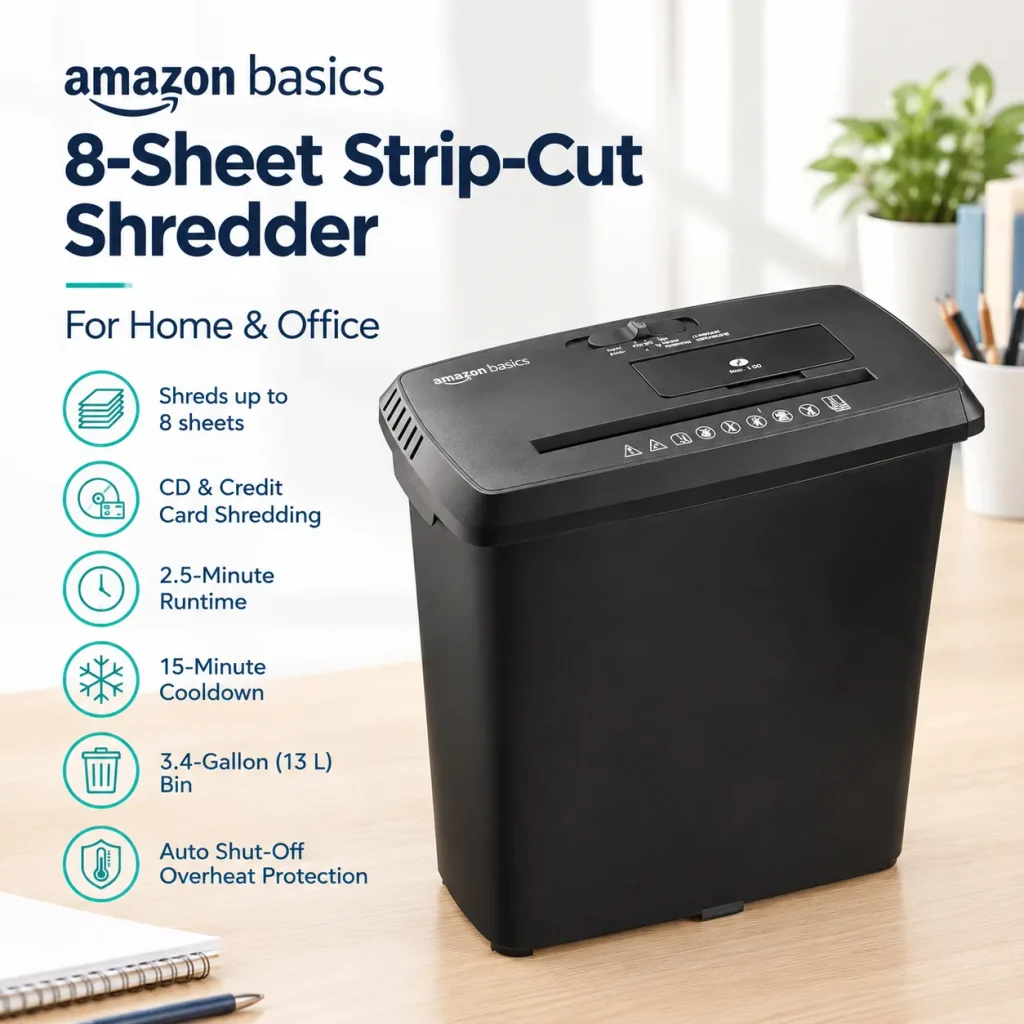
Documented specifications: P-2, up to 8 sheets, 3.4-gallon bin, 2.5-minute runtime, 15-minute cooldown.
Best for: Occasional, low-security paper disposal.
Limitation: Its P-2 rating and short runtime make it unsuitable for confidential paperwork or lengthy shredding sessions.
Bonsaii S120-C, 8-Sheet Strip-Cut
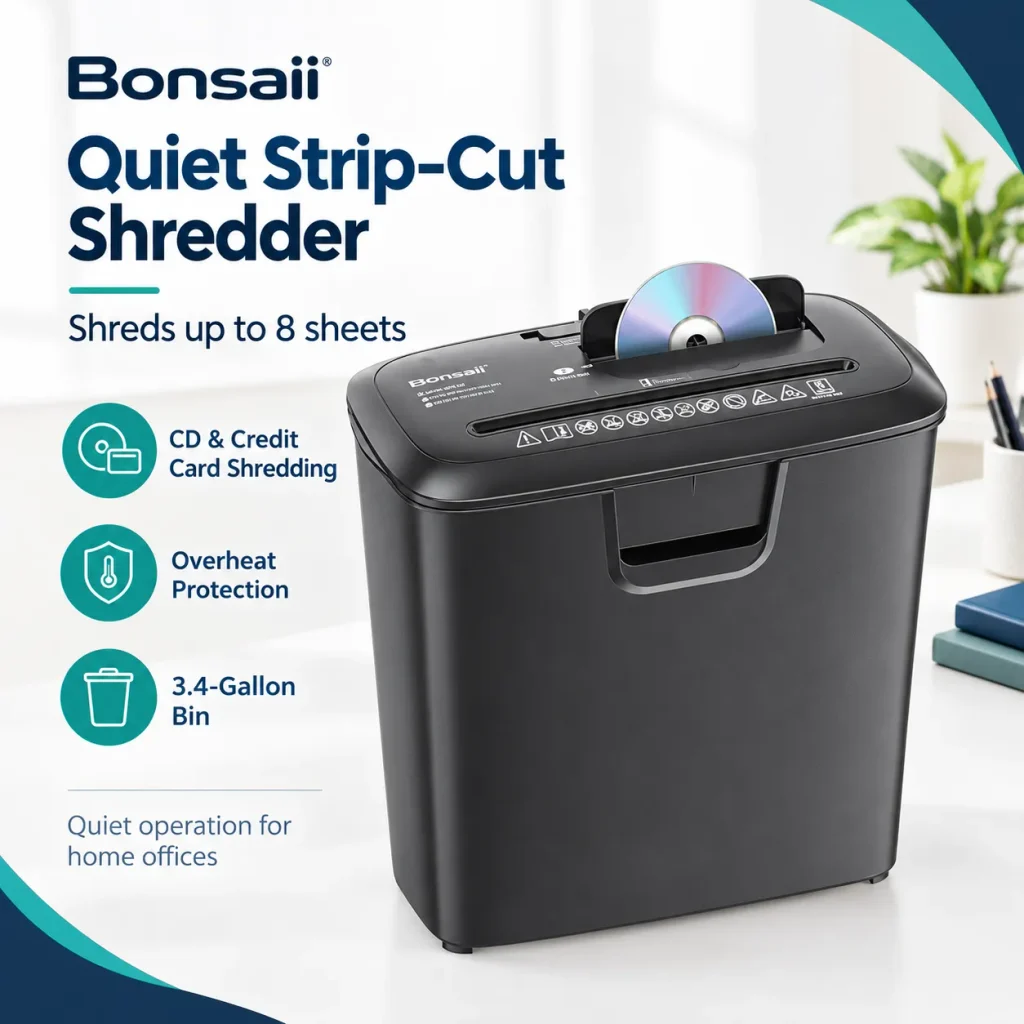
Manufacturer listing: 8-sheet capacity, 3.4-gallon bin, approximately 2-minute runtime, 15-minute cooldown, and a 12-month machine warranty.
Best for: Small, occasional batches of non-confidential paper.
Limitation: Its short duty cycle restricts larger jobs. Verify the security rating and exact specifications for the listing you buy.
Affiliate disclosure: As an Amazon Associate, ShredProInk earns from qualifying purchases. We may earn a commission if you buy through our links, at no extra cost to you.
A Practical Buying Example
Suppose a teacher needs to dispose of blank worksheets and generic drafts. A strip-cut machine may meet that need at a lower upfront cost. If the same teacher also handles student records containing personal information, the security decision changes: they should select a machine that meets the applicable requirements for those records.
This is an illustrative buying scenario, not a documented customer case study.
Frequently Asked Questions
Is a Strip-Cut Shredder Secure Enough for Home Use?
It depends on the documents, not the location. Strip-cut can suit generic paper waste, but a home shredder used for bank statements or identity documents should have a more appropriate documented security rating.
Can Shredded Strips Be Reconstructed?
Yes. Long strips may retain readable text and can potentially be pieced together. Smaller particles from higher-security shredders make reconstruction harder.
Is a Strip-Cut Shredder Suitable for Tax Documents?
Generally, no. Choose a shredder with an appropriate documented security level for your tax records and personal identifiers. Check any retention obligations before destroying financial paperwork.
Is Ribbon Cut the Same as Strip Cut?
Yes. Ribbon cut is commonly used as another name for strip-cut output, where paper becomes long, narrow strips.
Final Recommendation
The pros and cons of strip-cut shredders come down to one question: what are you destroying? Buy one for genuinely non-confidential paper if its capacity and runtime suit your workload. For financial, personal, or confidential records, choose a cross-cut or higher-security machine with a documented rating that meets your needs.