
For many households and home offices, a P-4 shredder is a sensible starting point for confidential paperwork. A P-5 shredder produces smaller particles and may suit documents that require a higher level of destruction. The right choice depends on your documents, workload, organizational policy, and budget, not simply which number is higher.
Before paying more for a finer cut, compare the particle-size limits, machine specifications, and level of security your records actually require.
P-4 vs P-5: What’s the Difference?
P-4 and P-5 are paper-destruction security levels under the DIN 66399 classification. The related international standards series, ISO/IEC 21964, covers the secure destruction of data carriers.
The main difference is the permitted size of the shredded paper particles.
P-4 particle size and typical uses
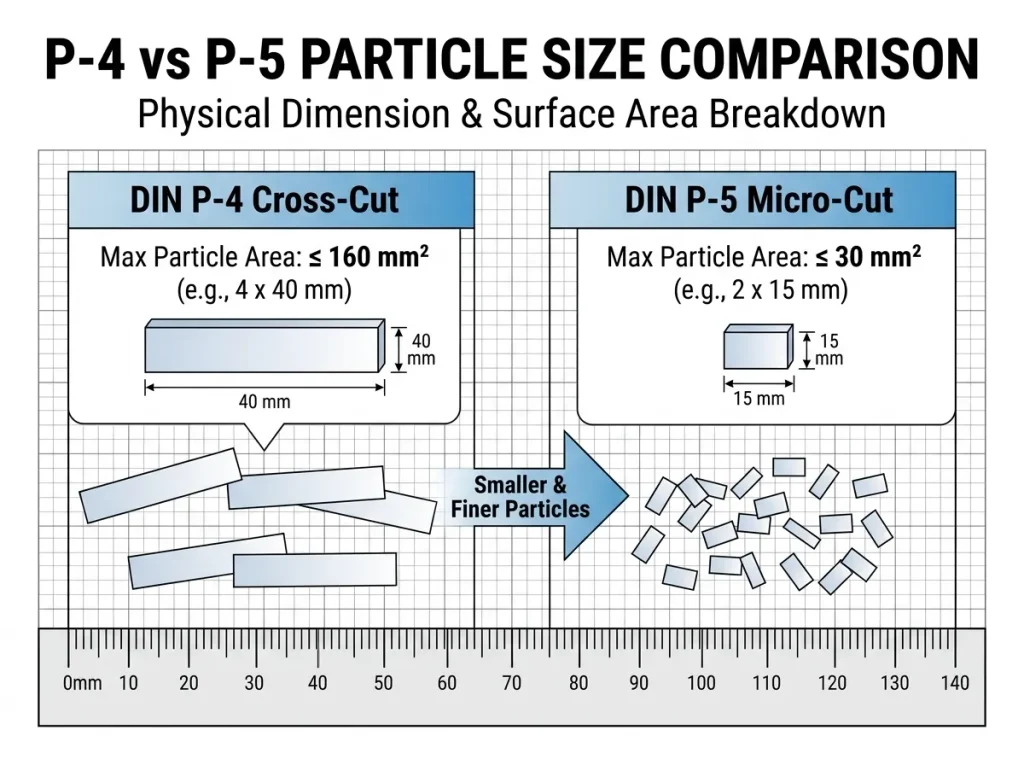
P-4 allows a maximum particle area of 160 mm². A common rectangular example is 4 × 40 mm.
This level suits many everyday confidential-paper needs, including bank statements, tax paperwork, invoices, personal records, and routine business documents. Check your organization’s requirements before treating P-4 as sufficient for a particular record type.
P-5 particle size and typical uses
P-5 reduces the maximum particle area to 30 mm². A common rectangular example is 2 × 15 mm.
The smaller output makes reconstruction more difficult and can make P-5 worth considering for highly sensitive financial information, personnel files, proprietary business records, or other material that warrants finer destruction.
What the particle-area difference actually means
| P Level | Example dimensions | Example particle area |
| P-4 | 4 × 40 mm | 160 mm² |
| P-5 | 2 × 15 mm | 30 mm² |
These are illustrative rectangular dimensions, not mandatory shapes for every compliant shredder. Verify the manufacturer’s declared P-level and specifications.
Using these examples, the difference is:
[(160-30)/(160)]*100=81.25%
The P-5 example has an area 81.25% smaller than the P-4 example. That does not mean P-5 is 81.25% more secure. The calculation compares particle areas, not real-world reconstruction probabilities.
For the complete P-1 to P-7 classification, read our DIN 66399 security-level guide.
P-4 vs P-5 Comparison Table
| Comparison factor | P-4 shredder | P-5 shredder |
|---|---|---|
| Maximum particle area | 160 mm² | 30 mm² |
| Common example dimensions | 4 × 40 mm | 2 × 15 mm |
| Typical cut description | Cross-cut or fine particle cut | Often micro-cut |
| General security use | Confidential documents | Higher-confidentiality documents |
| Home use | Often sufficient for routine sensitive paperwork | Worth considering for greater security needs |
| Small business | Routine confidential records, subject to policy | Higher-sensitivity records, subject to policy |
| Medical records | Depends on the required disposal process | Smaller particles, but no automatic compliance |
| Sheets per pass | Model-specific | Model-specific |
| Runtime and cooldown | Model-specific | Model-specific |
| Purchase price | Check current listings | Check current listings |
| Reconstruction risk | No universal probability established | No universal probability established |
Security rating, particle size and practical trade-offs
The P-level tells you about the paper destruction output. It does not tell you how quickly a machine will finish a stack of documents.
A shredder’s rated sheet capacity, feed speed, continuous runtime, cooldown period, and bin size determine how well it fits your workload. A P-5 model with a short runtime may be inconvenient for a large batch, even if its security rating suits your needs.
Sheet capacity, runtime and model-level specifications
Compare actual manufacturer specifications before buying. Do not assume every P-5 shredder handles fewer sheets or costs more than every P-4 model.
If you’re still choosing between cut types, our guide to how micro-cut shredders produce smaller particles explains the technology. You can also read what a micro-cut shredder is before comparing individual models.
Which Security Level Do You Need?
The best P-4 or P-5 paper shredder depends on the most sensitive documents you handle, your workload, and any security rules you must follow.
Quick decision guide
Home use: Start with P-4
Bank statements, tax returns, personal mail, and ordinary confidential paperwork are common reasons to consider P-4. Check the machine’s runtime and capacity if you shred large batches during tax season.
Small business: Match the rating to your policy
P-4 may suit routine invoices, customer records, and employee paperwork. Consider P-5 when the information is more sensitive or your organization’s documented policy calls for finer destruction.
Medical and legal records: Check the applicable requirements
P-5 may be appropriate for higher-confidentiality records, but the security rating alone does not establish legal or regulatory compliance.
P-4 for home use and everyday confidential paperwork
For many privacy-conscious consumers, P-4 offers a practical balance between fine particle destruction and everyday usability. It is a reasonable choice when your documents need confidential disposal but no stricter requirement dictates a higher level.
Before buying, check how many sheets the shredder handles per pass, how long it can run, and how much paper its bin holds. Those specifications matter when you have a pile of documents to clear.
When P-5 is worth considering
Choose P-5 when your documents justify smaller particles, your organization specifies that level, or you want a finer destruction standard for particularly sensitive information.
The additional security is most useful when it addresses a real requirement. Paying more simply to obtain a higher number may add cost without solving a problem you actually have.
P-4 vs P-5 for medical and business records
The U.S. Department of Health and Human Services explains that paper protected health information must be destroyed or handled so it becomes essentially unreadable, indecipherable, and not reconstructable before disposal in an accessible trash receptacle. Its guidance does not prescribe P-5 as a universal shredder rating. Read the official HHS disposal guidance.
Healthcare and legal organizations should follow their documented disposal procedures and consult their compliance officer when selecting equipment. A P-5 shredder does not automatically make an organization HIPAA-compliant.
How Much More Does a P-5 Shredder Cost?
There is no reliable universal price difference between P-4 and P-5 shredders. Prices vary by manufacturer, capacity, intended workload, and machine features. A valid comparison needs current US prices for models that serve similar needs.
Compare like-for-like models and ownership costs
Before deciding, compare these specifications:
- Purchase price: Check the current listing and whether the product is available in the US.
- Sheet capacity: Compare the manufacturer’s rated sheets per pass.
- Runtime and cooldown: A longer operating period can matter more than a small price difference when shredding large batches.
- Bin capacity: A larger bin can reduce interruptions.
- Warranty and maintenance: Review coverage, oiling requirements, and any relevant ongoing costs.
Do not assume that every P-5 model costs more or has lower capacity than every P-4 model. Those differences need evidence from the specific products being compared.
When the extra expense is justified
P-5 is worth considering when the finer particle limit meets a genuine security need. P-4 may be the more sensible purchase when it meets your requirements and provides the capacity and runtime your household or office needs.
For a broader view of features, workload, and ownership costs, see our complete paper shredder buying guide.
Best P-4 and P-5 Shredders to Consider
The right choice must meet your security requirement without creating unnecessary interruptions. It depends on how often you shred documents and how sensitive the information is. A P-4 shredder suits many everyday household and small-office needs, while P-5 offers smaller particles for records that require a higher level of confidentiality.
Best P-4 Shredder for Everyday Use
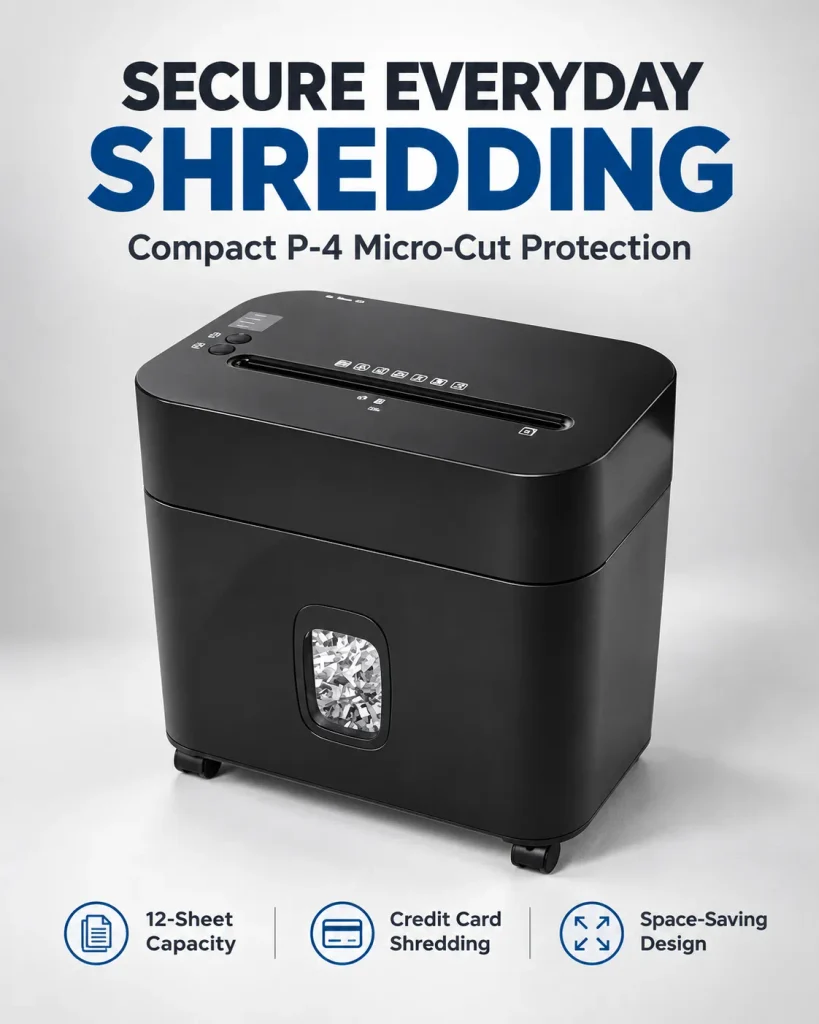
Staples 12-Sheet Micro-Cut Paper Shredder
The Staples 12-sheet micro-cut shredder is a practical option for households and small offices that regularly dispose of bills, statements, and other personal paperwork. Its compact design suits smaller workspaces, and it can shred credit cards alongside paper.
Recommended buyer: Home-office users handling bank statements, personal records, invoices, and routine confidential paperwork.
Key specifications
- Security level: P-4 micro-cut
- Capacity: Up to 12 sheets per pass
- Bin capacity: 1.8 gallons
- Additional capability: Shreds credit cards
- Design: Compact, with low-noise operation advertised by the manufacturer
Why consider it: It offers a straightforward option for routine document disposal without the larger footprint or higher purchase price of the P-5 model below.
Keep in mind: The 1.8-gallon bin is relatively small, so frequent shredding may mean emptying it more often. If you regularly handle highly confidential client, legal, or medical records, compare its P-4 security level with your organization’s document-disposal policy before buying.
Limitation: P-4 may not meet a stricter organizational requirement for finer destruction.
Best P-5 Shredder for Higher-Confidentiality Needs
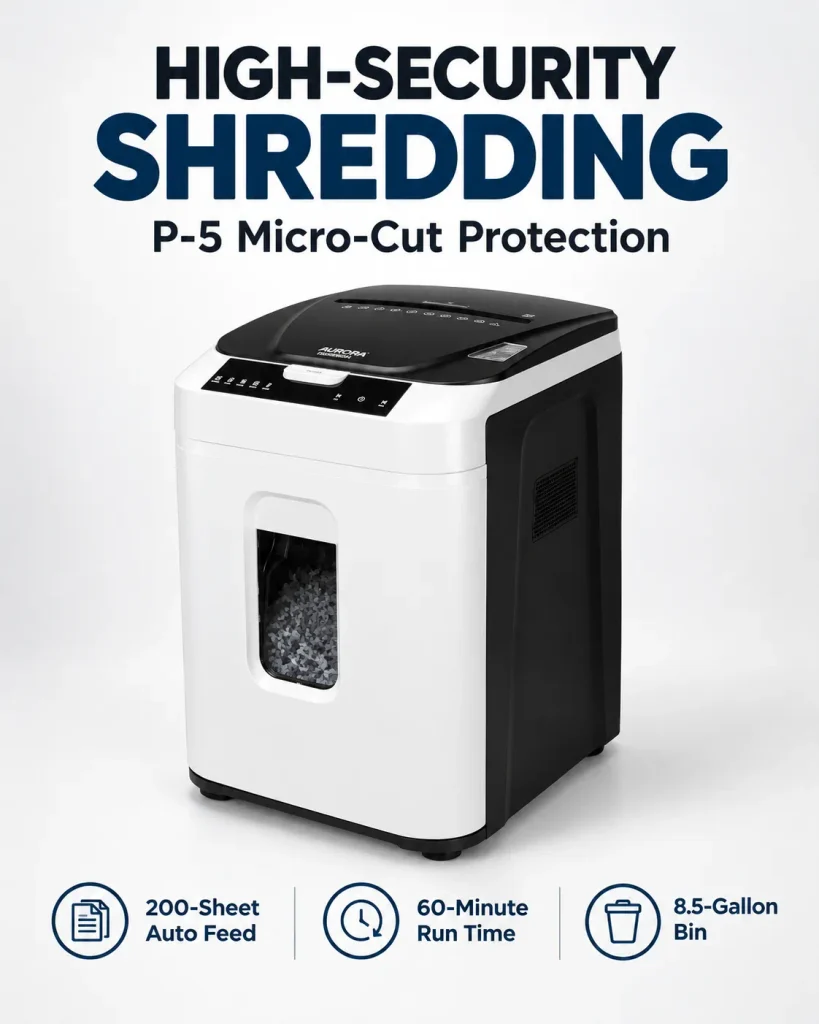
Aurora 200-Sheet Auto-Feed High-Security Micro-Cut Shredder
The Aurora P-5 model is aimed at people and offices that need finer paper shredding and want to process larger batches with less manual feeding. Its auto-feed system handles up to 200 sheets, and the manufacturer lists a continuous run time of up to 60 minutes.
Recommended buyer: Users who need finer particle destruction for highly sensitive personal or business records.
Key specifications
- Security level: P-5 micro-cut
- Auto-feed capacity: Up to 200 sheets
- Manual-feed capacity: Up to 10 sheets
- Particle dimensions: Approximately 2 × 12 mm
- Run time: Up to 60 minutes
- Bin capacity: 8.5 gallons
- Other features: Anti-jam auto-reverse, auto power-sleep, and status indicator lights
Why consider it: The larger bin and automatic feeding can help when you need to shred substantial batches of confidential paperwork. Its P-5 classification produces smaller particles than P-4, making it a stronger fit when document sensitivity justifies the extra cost.
Keep in mind: At $379.98, it costs considerably more than the Staples model. Its larger capacity may be unnecessary if you only shred a few pages each week. Check the manufacturer’s specifications and your organization’s requirements before treating any shredder as suitable for regulated records.
Limitation: A finer cut does not guarantee adequate throughput or satisfy every regulatory requirement.
Affiliate disclosure: As an Amazon Associate, ShredPro Ink earns from qualifying purchases. We may earn a commission if you buy through our links, at no extra cost to you.
Frequently Asked Questions
Is P-4 enough for home use?
P-4 is a reasonable starting point for many households that shred confidential financial records, personal paperwork, and mail. If you have stricter security requirements, compare P-5 and confirm which level your situation requires.
Do medical records need P-5?
Not universally. HHS does not prescribe P-5 as the required rating for every paper medical record. Healthcare organizations should follow applicable requirements and documented disposal procedures rather than relying on the P-level alone.
Can shredded paper be reconstructed?
Reconstruction may be possible in some circumstances, depending on the size and condition of the fragments, the document, and the resources available. Smaller particles generally make the task more difficult, but there is no universal reconstruction probability that can be assigned to all P-4 or P-5 shredders.
When should you upgrade from P-4 to P-5?
Consider upgrading when your document sensitivity increases, your organization’s policy requires P-5, or a specific security assessment supports finer destruction. Check runtime and sheet capacity before buying so the new shredder can handle your actual workload.
Final Verdict: P-4 or P-5?
For many households and home offices, P-4 is a sensible starting point for confidential paperwork. P-5 is worth considering when you need smaller paper particles for higher-confidentiality records or must meet a stricter documented requirement.
Compare the declared P-level first, then check capacity, runtime, cooldown, bin size, and total ownership cost. The best shredder is the one that meets your security needs and handles your workload without unnecessary expense.
Ready to compare your options? Start with our paper shredder buying guide and choose a machine that fits both your documents and your daily routine.
Editorial disclaimer: This article provides general product-selection information, not legal advice or a guarantee of regulatory compliance. Confirm applicable requirements with your organization’s compliance officer or legal adviser.
Editorial case study: Choosing a shredder for a home office
Consider a home office that regularly destroys bank statements, tax documents, invoices, and client paperwork. The owner initially considers P-5 for every document, assuming a higher security level is always the better investment.
A closer review shows that the owner first needs to identify the most sensitive records, check any client or organizational requirements, and estimate the volume of paper processed each week. If P-4 meets those requirements, a model with a suitable runtime and larger bin may offer a better fit than a P-5 model that needs frequent cooling breaks.
If the workload later includes information subject to a stricter destruction policy, the owner should reassess the required P-level before purchasing a replacement.
This is an illustrative scenario, not a documented ShredPro Ink customer case study or a product test.