
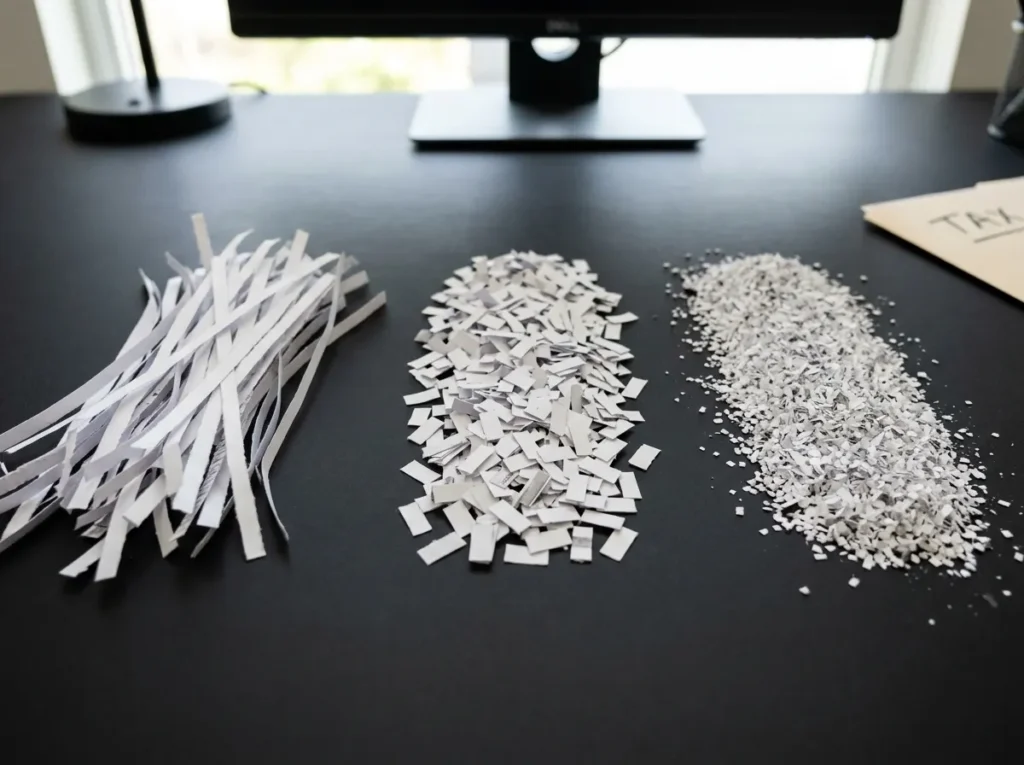
If you’re comparing cross cut vs micro cut vs strip cut, don’t choose by the name alone. The right shredder depends on what you destroy, how sensitive the information is, and how much paper you need to process.
| Cut type | Security direction | Best fit | Main trade-off |
|---|---|---|---|
| Strip-cut | Lower | Non-sensitive paper | Lowest document security |
| Cross-cut | Medium to higher | Personal and everyday confidential records | Less fine than micro-cut |
| Micro-cut | Higher | Highly sensitive documents | Often slower and costs more |
For most home offices handling personal and confidential paperwork, cross-cut is a practical starting point. If you regularly destroy highly sensitive financial, business, or other confidential records, a finer cut with an appropriate DIN security level may make more sense.
The key is to match the cut type and DIN 66399 P-level to the information you’re destroying, then check sheet capacity, run time, cooling period, and bin capacity.
Affiliate Disclosure: As an Amazon Associate, ShredProInk earns from qualifying purchases. We may earn a commission if you buy through our links, at no extra cost to you.
Strip-Cut vs Cross-Cut vs Micro-Cut at a Glance
The three common paper shredder cut types differ mainly in how they reduce a sheet. Strip-cut machines produce long strips. Cross-cut machines cut in two directions to create shorter particles. Micro-cut machines produce much smaller particles.
That difference affects security, waste volume, speed, and often the price of the machine.
| Factor | Strip-Cut | Cross-Cut | Micro-Cut |
|---|---|---|---|
| Cutting method | Long strips | Two-direction cuts | Very fine particles |
| Security | Lower | Medium to higher | Higher |
| Typical DIN range | P-1 to P-2 | P-3 to P-4 | Often P-4 to P-5, with higher-security models beyond this |
| Speed | Usually faster | Middle ground | Often slower |
| Waste volume | Higher | Lower | Lower |
| Typical cost | Lower | Mid-range | Often higher |
| Best fit | Low-risk paper | Personal and confidential records | Highly sensitive records |
The DIN classification deserves attention here. A manufacturer may call a machine “micro-cut,” but that label alone does not tell you its exact security level. The particle dimensions and stated DIN rating matter more.
Fellowes, for example, currently groups strip-cut shredders around P-1 and P-2, cross-cut around P-3 and P-4, and micro-cut around P-5, while its product range includes P-4 machines marketed with finer terminology such as mini-cut.
That is why “micro-cut” should be treated as a useful product category, not a substitute for checking the P-level.
What Is a Strip-Cut Shredder?
A strip-cut shredder uses rotating cutters to turn a sheet of paper into long, narrow strips. The result is easy to recognize: instead of small particles, you get pieces that can remain quite long.
How Strip-Cut Shredding Works
The cutting mechanism makes a series of straight cuts through the paper. The machine does not make the second set of cuts that cross-cut and finer shredders use to reduce the document into smaller pieces.
That simpler cutting process can make strip-cut shredders attractive when security is not the main concern.
Security and Particle Size
Strip-cut models generally occupy the lower end of the DIN 66399 paper-security range. Fellowes currently lists strip-cut as P-1 and P-2 and describes these levels as suitable for low-risk, non-confidential information.
That means you should not treat every strip-cut shredder as suitable for documents containing personal information simply because the paper has been cut into pieces.
When Strip-Cut Makes Sense
Strip-cut can make sense for paper that contains little or no sensitive information.
Examples include:
- General junk paper with no personal details
- Duplicate drafts that you no longer need
- Non-confidential internal material
- Low-risk classroom or household paper
The main attraction is simple: you can get basic shredding without paying for a finer cutting mechanism.
Strip-Cut Limitations
The problem appears when the paper contains information someone could use or reconstruct.
Bank statements, tax records, documents containing account numbers, and papers containing personally identifiable information deserve more careful treatment. The FTC recommends disposing of sensitive paper records in a way that prevents the information from being read or reconstructed.
If your shredder will handle personal or confidential documents regularly, strip-cut is usually not where we’d start.
What Is a Cross-Cut Shredder?
A cross-cut shredder cuts paper in two directions, producing much shorter particles than a strip-cut machine.
That gives you a useful middle ground between basic shredding and the finer particles produced by micro-cut models.
How Cross-Cut Shredding Works
Instead of making only straight cuts, the cutters create smaller pieces across the width and length of the sheet.
The result is less paper volume than long strips and a harder-to-reconstruct document.
Cross-Cut Security Levels
Cross-cut models commonly appear at P-3 and P-4, but you should verify the actual DIN rating rather than assuming every cross-cut machine has the same security level. Fellowes currently describes P-3 and P-4 as its cross-cut range.
This matters when you’re comparing two machines that both advertise themselves as “cross-cut.” Their actual particle sizes can be different.
For a deeper explanation of these classifications, see our DIN 66399 security levels explained guide.
Why Cross-Cut Is a Popular Middle Ground
Cross-cut often fits the person who wants meaningful document security without automatically choosing the finest possible cut.
A home office professional, for example, may shred invoices, client paperwork, financial mail, and everyday personal records. The priority isn’t simply “make the smallest particles possible.” It’s finding a machine that provides an appropriate security level while keeping the workflow manageable.
See our Top models rated for everyday security.
When Is Cross-Cut Enough?
For many household and home-office situations, a cross-cut machine with an appropriate DIN rating can be a sensible choice.
The exact answer depends on the documents. A page containing a name and address is different from a document containing account credentials, extensive financial information, or highly confidential business material.
If you’re unsure how much protection you need, use our guide to how much shredder security you need before choosing a machine.
What Is a Micro-Cut Shredder?
A micro-cut shredder reduces paper into much smaller particles than a typical cross-cut machine.
The smaller output can provide a higher level of document destruction, but you should expect trade-offs in machine speed, price, and sometimes operating requirements.
How Micro-Cut Shredding Works
Micro-cut shredders make many more cuts through the sheet, producing tiny particles rather than relatively large cross-cut pieces.
That reduces the size of each individual piece and can make reconstruction much harder.
Micro-Cut Security Levels
The term “micro-cut” needs a little caution.
Fellowes currently associates micro-cut with P-5 in its security guide, while its product range also includes P-4 machines using finer terminology such as mini-cut. Other manufacturers may use “micro-cut” differently.
So don’t stop at the product title.
Check the stated DIN 66399 P-level and particle dimensions before comparing two shredders.
Why Micro-Cut Produces Smaller Particles
More cutting produces smaller pieces. Smaller particles mean less usable information remains on each individual piece and more pieces must be dealt with if someone attempts reconstruction.
Fellowes’ current guidance illustrates this progression from P-1/P-2 strips through P-3/P-4 cross-cut particles and P-5 micro-cut particles.
Micro-Cut Trade-Offs
Higher security can come with practical costs.
A finer cutting mechanism may process paper more slowly, and the machine may cost more. Maintenance can matter too, particularly if you’re processing large amounts of paper.
That’s why micro-cut is not automatically the right answer for every buyer.
If you’re shredding 20 pages of personal mail each week, paying for a high-security machine may solve a problem you don’t actually have. If you’re processing highly confidential business records every day, the extra security may make more sense.
See our micro-cut shredder guide for deep analysis
Particle Size: The Difference You Can Actually See
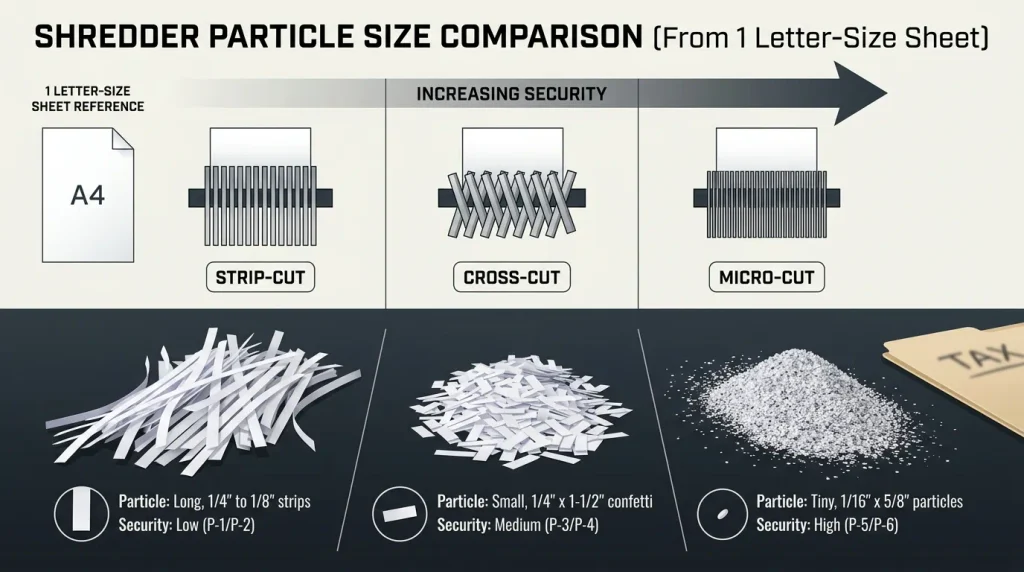
The easiest way to understand paper shredder security is to look at the physical output.
A strip-cut shredder leaves long pieces. A cross-cut shredder produces shorter particles. A micro-cut shredder produces much finer particles.
That physical difference matters more than the marketing label on the front of the machine.
Why Smaller Particles Increase Destruction Security
A long strip can preserve a large amount of the original page’s information. Smaller particles break the document into more separate pieces.
DIN 66399 uses security levels from P-1 through P-7 for paper destruction. As the P-number increases, the permitted particle size becomes smaller.
A useful high-level view is:
| DIN level | General cut direction | Security direction |
|---|---|---|
| P-1 | Strip-cut | Basic |
| P-2 | Strip-cut | Basic |
| P-3 | Cross-cut commonly used | Higher |
| P-4 | Cross-cut or finer cuts | Higher |
| P-5 | Micro-cut commonly used | Superior |
| P-6 | High-security micro-cut | Very high |
| P-7 | High-security micro-cut | Maximum |
This is a classification guide, not a rule that says every P-4 machine must be called cross-cut or every P-5 machine must use the word micro-cut.
Why Particle Size Matters More Than the Marketing Name
The word “micro-cut” sounds precise, but it isn’t enough information to compare machines.
For example, Fellowes currently lists P-4 cross-cut products and P-4 mini-cut products, while its P-5 products use micro-cut terminology.
That is the exact reason we recommend checking:
- DIN P-level
- Actual particle dimensions
- Cut type
- Intended document sensitivity
Don’t buy a shredder because the box says “high security.” Find the measurable specification behind the claim.
How DIN 66399 Security Levels Fit Into Cut Types
DIN 66399 is a standard used to classify the secure destruction of data carriers, including paper. DIN’s standards committee describes its work as covering physical destruction of data carriers and requirements intended to prevent data recovery.
For paper shredders, the P-level is the part you’ll see most often.
P-1 and P-2: Lower Security
P-1 and P-2 sit at the lower end of paper destruction security and are commonly associated with strip-cut shredders.
They’re better suited to low-risk material where the paper does not contain sensitive personal or business information.
P-3 and P-4: Common Cross-Cut Territory
P-3 and P-4 are commonly associated with cross-cut shredders.
P-4 deserves special attention because manufacturers can use different cut-type labels around this level. A P-4 machine may be described as cross-cut, mini-cut, or another finer-cut category depending on the manufacturer.
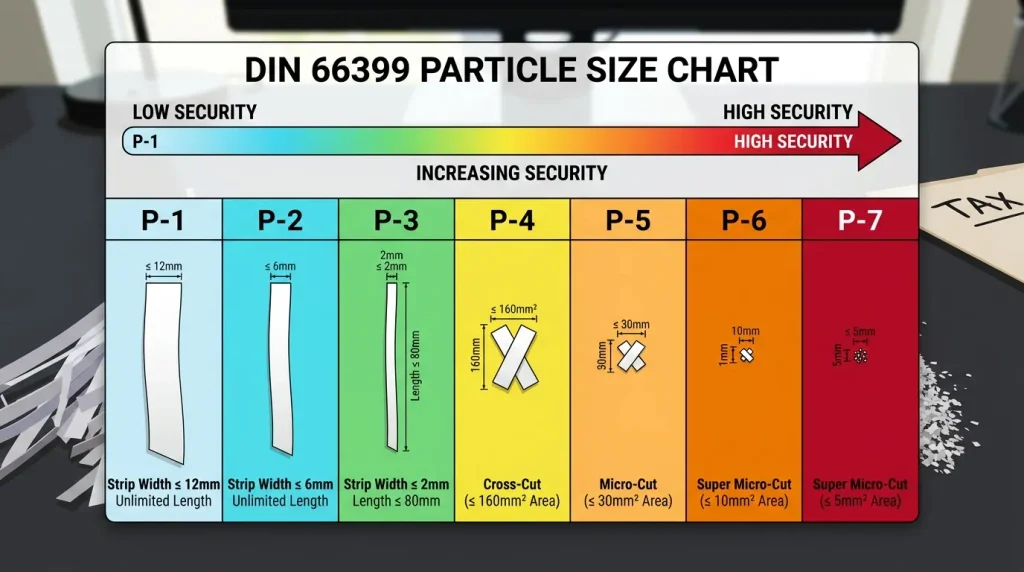
P-5 and Above: Finer Security Cuts
P-5 moves into finer particle sizes and is commonly associated with micro-cut shredders. P-6 and P-7 go further for highly sensitive or classified material.
For most household buyers, the practical question isn’t whether P-7 is “better.” It’s whether the higher security level solves a real requirement.
Why Cut Type and P-Level Are Not Always the Same
Think of it this way:
Cut type describes how the machine cuts. DIN P-level describes the resulting security classification.
The two are related, but they aren’t interchangeable.
For the full classification, see our DIN 66399 / P-levels guide.
Cross-Cut vs Micro-Cut vs Strip-Cut: Security Comparison
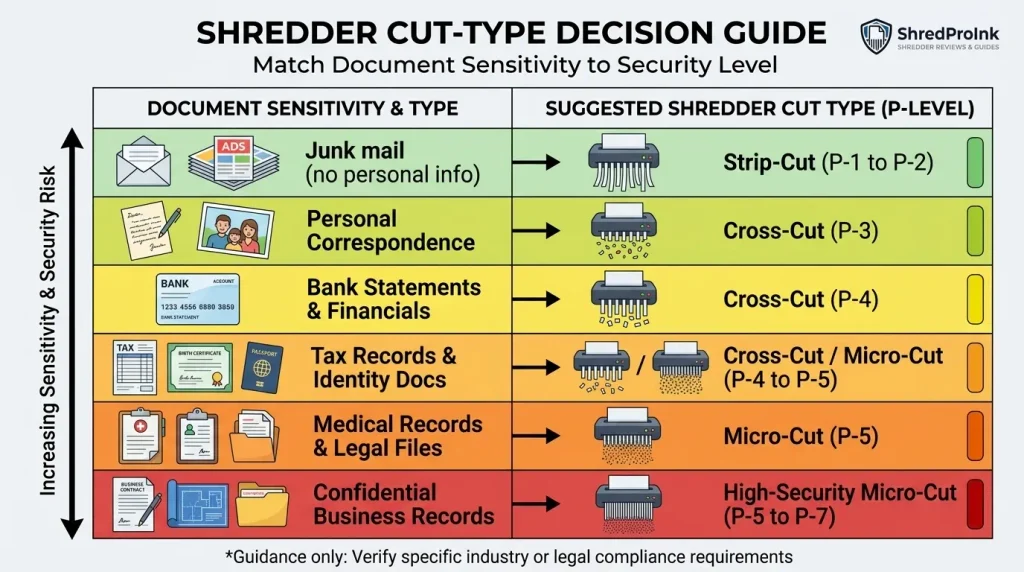
Your document determines the starting point.
| Document type | Practical direction |
|---|---|
| Junk mail with no personal information | Strip-cut may be sufficient |
| Personal correspondence | Cross-cut is a reasonable starting point |
| Bank and financial records | Cross-cut or finer, depending on sensitivity |
| Tax documents | Cross-cut or micro-cut, with workload considered |
| Medical records | Use an appropriate security level and verify applicable requirements |
| Confidential business records | Finer security may make sense, especially for higher-risk material |
These are buying directions, not legal requirements.
The FTC says businesses should use reasonable disposal practices based on the sensitivity of information and other factors, and recommends shredding, burning, or pulverizing sensitive paper records so they cannot be read or reconstructed.
For healthcare information, HHS says covered entities should destroy paper PHI so it is essentially unreadable, indecipherable, and cannot be reconstructed. HHS does not say that buying a particular shredder cut type automatically makes an organization HIPAA compliant.
Compliance note: A shredder’s P-level is one part of a document-disposal process. It does not, by itself, establish HIPAA, GDPR, FACTA, or any other legal compliance status.
Speed, Capacity and Duty Cycle
Security is only half the buying decision.
A shredder that produces extremely fine particles isn’t much help if you have a large backlog and the machine needs frequent cooling periods.
Why Strip-Cut Is Usually Faster
Strip-cut machines make fewer cuts through each sheet, so the cutting process is simpler.
That can make them attractive for low-risk, high-volume disposal where document security requirements are limited.
Why Finer Cuts Can Reduce Throughput
Finer particle sizes require more cutting.
That can affect shredding speed and operating time. You should compare the manufacturer’s stated sheet capacity and duty cycle rather than assuming one machine is faster because it has a higher sheet-count number.
Sheet Capacity vs Actual Workload
A “12-sheet” rating means the manufacturer rates the machine for up to 12 sheets under stated test conditions. It doesn’t mean you should feed 12 sheets every time.
Paper weight, humidity, folded sheets, and other conditions can reduce actual capacity. Manufacturer documentation for the Fellowes 60Cs, for example, notes that heavier paper and other conditions can reduce capacity.
Run Time and Cooling Time
Duty cycle tells you how long a shredder can operate before it needs a break.
This matters most during tax-season cleanouts, office filing projects, and other large batches.
A useful calculation is:
Total shredding time = paper volume ÷ practical throughput
Then account for cooling periods.
A machine with a lower sheet capacity but a long run time may be more useful for a large backlog than a machine with a higher sheet rating and a very short duty cycle.
Which Shredder Cut Is Best for Your Situation?
There isn’t one cut type that fits every buyer.
Best Cut for General Home Use
If you’re mainly destroying low-risk household paper, strip-cut can work.
If the paper contains personal information, move up to a cross-cut model with an appropriate DIN rating.
Best Cut for a Home Office
For a home office professional, cross-cut is often the practical starting point.
You may be destroying invoices, client paperwork, personal mail, financial documents, and other confidential material. You need enough security without turning routine shredding into a slow process.
This is exactly the kind of workflow where cut type, noise, sheet capacity, and run time matter together.
Best Cut for Tax Documents
Tax paperwork deserves more attention than ordinary junk mail.
Look at the security level first, then workload. If you have several years of records to process, a shredder with a short duty cycle can become frustrating quickly.
Before shredding, confirm that the records are actually eligible for disposal. Shredding a document you still need is a security problem of a different kind.
Best Cut for Small Business
Small businesses should look beyond particle size.
A good choice needs to balance:
- Document sensitivity
- Daily volume
- Sheet capacity
- Duty cycle
- Bin capacity
- Maintenance
- Replacement cost
For an office processing client records every day, buying the cheapest machine can create more downtime than it saves in purchase price.
See our small-office shredder recommendations when the workload moves beyond occasional home use.
Best Cut for Medical or Legal Records
Medical and legal records require careful handling.
Don’t choose a shredder based on a claim such as “HIPAA compliant” printed on a product page. HHS requires appropriate safeguards and says paper PHI should be destroyed so it cannot be read or reconstructed, but the regulation does not turn a particular consumer shredder label into a compliance certificate.
If your organization has a specific regulatory or contractual requirement, confirm it with your compliance officer or counsel.
Best Cut for High-Volume Shredding
High-volume users should prioritize the entire machine specification.
A finer cut can reduce shredded-paper volume, but your workflow still depends on the cutter speed, sheet capacity, run time, cooling period, and bin size.
Don’t buy based on P-level alone.
Worked Example: A Home Office Tax-Season Purge
This is an illustrative buying case, not a hands-on product test.
Imagine a remote consultant with a home office who has accumulated several boxes of old financial paperwork.
The documents include bank statements, invoices, tax records, and personal correspondence.
A strip-cut shredder may provide basic disposal, but the document sensitivity makes it a weak starting point.
A cross-cut shredder with an appropriate P-level could provide a better balance if the volume is moderate.
A micro-cut machine may make more sense if the reader wants finer particle destruction and accepts potentially slower processing and higher cost.
Now add the workload.
If the machine only runs for a few minutes before requiring a long cooling period, the user may spend much longer clearing the backlog than expected.
The decision is therefore not “micro-cut wins.”
The decision becomes:
document sensitivity → appropriate P-level → required workload → run time → sheet capacity → bin size → price.
That is the buying sequence we recommend.
See our complete buying methodology for choosing the right model for your job.
Recommended Shredders by Cut Type
The models below are examples to illustrate the three categories. ShredProInk recommendations should be refreshed against current manufacturer specifications, independent reviews, verified-purchase feedback, pricing, and availability before publication. We do not claim hands-on testing where none has occurred.
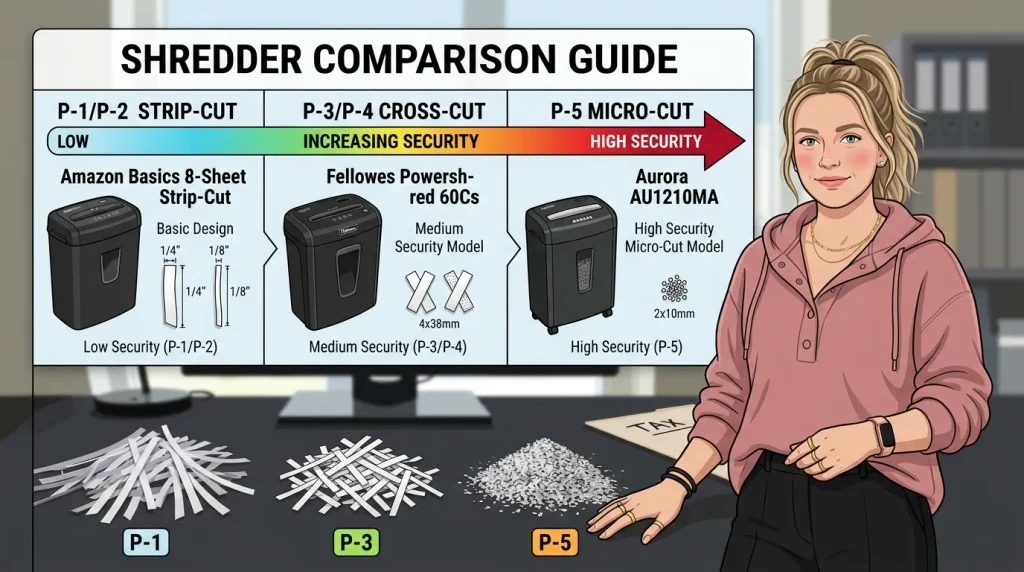
Amazon Basics 8-Sheet Strip-Cut Shredder
Best For: Low-risk paper where basic shredding is enough.
- Cut type: Strip-cut
- Security: P-2
- Sheet capacity: Up to 8 sheets
- Run time: Model-dependent; verify the current listing
- Bin: Model-dependent
- Main limitation: Not the right starting point for sensitive personal or confidential records
The Amazon Basics 8-sheet strip-cut models are positioned around basic document destruction, with current documentation identifying P-2 security on the S120-E model.
Fellowes Powershred 60Cs
Best For: Personal and home-office shredding where P-4 cross-cut security fits the workload.
- Cut type: Cross-cut
- Security: P-4
- Sheet capacity: 10 sheets
- Run time: 6 minutes on, 20 minutes off
- Bin: 6 gallons
- Main limitation: The short duty cycle can make large shredding backlogs slow
Fellowes lists the 60Cs as a 10-sheet P-4 cross-cut model with a 6-minute on / 20-minute off duty cycle and a 6-gallon bin.
Aurora AU1210MA
Best For: Buyers who want a finer-cut machine and longer stated operating time.
- Cut type: Manufacturer calls it micro-cut
- Security: P-4
- Sheet capacity: 12 sheets
- Run time: 60 minutes continuous
- Bin: 5 gallons
- Main limitation: Its “micro-cut” label does not mean P-5; the manufacturer specifies P-4
Aurora lists the AU1210MA as a 12-sheet micro-cut shredder with 5/32 × 15/32-inch particles, P-4 security, a 60-minute continuous run time, and a 5-gallon bin.
This is a useful example of why you should read the DIN rating rather than assume the cut-type name tells the entire story.
Common Mistakes When Choosing a Shredder Cut
Buying Based Only on “Micro-Cut” Marketing
Micro-cut sounds more secure, but the product’s DIN rating and particle dimensions give you better information.
Ignoring the DIN Security Level
Two machines can use different marketing names while producing particles that fall into different security classifications.
Buying More Security Than Your Workload Requires
P-7 may be unnecessary for ordinary household mail. More security can mean higher purchase cost and different performance characteristics.
Ignoring Duty Cycle
A high sheet-count rating doesn’t tell you how long the motor can keep working.
Assuming “Micro-Cut” Automatically Means P-5
It doesn’t.
The Aurora AU1210MA, for example, is marketed as micro-cut but is specified by Aurora as P-4.
Assuming a Machine Makes You Legally Compliant
It doesn’t.
Document security is part of a broader process. HHS guidance focuses on making PHI unreadable and non-reconstructable before disposal, rather than certifying a particular consumer shredder.
Frequently Asked Questions
Is Micro-Cut Better Than Cross-Cut?
Micro-cut generally produces smaller particles than standard cross-cut, which can provide a higher level of document destruction. But the best choice depends on the DIN level, document sensitivity, workload, and machine specifications.
Is Cross-Cut Secure Enough for Home Use?
For many home users handling personal and confidential documents, a suitable cross-cut shredder can be a practical choice. Check the actual DIN P-level rather than assuming every cross-cut model provides the same security.
What Is the Difference Between Strip-Cut and Cross-Cut?
Strip-cut produces long strips from a sheet. Cross-cut cuts in two directions, producing smaller particles. That makes cross-cut a better fit when you’re destroying personal or confidential information.
What Is the Most Secure Type of Paper Shredder?
The highest DIN paper-security levels are P-6 and P-7. These produce much finer particles than basic strip-cut models and are intended for very high-security destruction.
Is a Micro-Cut Shredder Worth It?
It can be if you regularly destroy highly sensitive information and want finer particle destruction. It may be unnecessary if your documents have low sensitivity or your workload makes a shorter duty cycle more important.
What Shredder Type Is Best for Tax Documents?
A cross-cut or micro-cut shredder with an appropriate DIN rating can make sense for tax documents. The decision should account for document sensitivity and the amount of paper you need to process.
What Shredder Type Is Best for Home Offices?
Cross-cut is a practical starting point for many home offices handling personal and confidential paperwork. Check the P-level, run time, sheet capacity, noise, and bin size before buying.
Is Strip-Cut Still Useful?
Yes. Strip-cut can make sense for low-risk, non-confidential paper where basic disposal is the main requirement. It becomes less suitable when documents contain sensitive personal or business information.
What Is P-4?
P-4 is a DIN 66399 paper-security level with smaller permitted particles than P-3. Manufacturers may describe P-4 machines using different cut-type terms, which is why checking particle size and the stated DIN level matters.
What Is P-5?
P-5 is a higher DIN paper-security level associated with much finer particle sizes than P-4. Fellowes currently associates P-5 with micro-cut shredders for highly confidential information.
Does Micro-Cut Take Longer?
It can. Finer cutting requires more cutting action, and manufacturers may specify different shredding speeds and duty cycles. Compare the actual run-time and speed specifications instead of assuming every micro-cut machine is slower.
Which Shredder Type Should I Buy?
Start with the information you’re destroying. Use strip-cut for low-risk paper, cross-cut for many everyday confidential-document needs, and finer security cuts when the sensitivity of the records justifies them. Then check DIN level, particle size, workload, run time, capacity, and cost.
The Bottom Line: Match the Cut to the Job
The real answer to cross cut vs micro cut vs strip cut isn’t “buy the smallest shred.”
Strip-cut works for low-risk paper. Cross-cut gives many home and office users a stronger security-to-workflow balance. Micro-cut can make sense when finer particle destruction matters more than speed or price.
The smartest way to choose is:
Document sensitivity → DIN P-level → particle size → workload → duty cycle → sheet capacity → bin size → price.
That approach keeps you from paying for security you don’t need or buying a machine that can’t keep up with the paper you actually have.
When you’re ready to compare specific models, move from this cut-type comparison to our complete paper shredder buying guide and then our best paper shredders recommendations.
Author: Umer Hussain researches and writes ShredProInk’s paper shredder buying guides, cross-referencing manufacturer specifications, DIN 66399 security ratings, and verified buyer feedback to help readers match a shredder to their actual document-security needs. See our Editorial Methodology for how recommendations are built.
For compliance-adjacent decisions, consult your organization’s compliance officer or counsel. ShredProInk explains document-security standards but does not certify individual compliance.