

Tax paperwork creates a very different shredding job from your normal weekly mail pile. Old tax returns, W-2s, 1099s, bank statements, receipts, and pay stubs can leave you with several folders to clear at once.
The best shredder for tax documents needs more than a high sheet-count rating. You need the right balance of security level, cut type, sheet capacity, runtime, cooling time, and bin size.
We compared current manufacturer specifications, independent review data, and documented buyer feedback patterns to identify five models for different tax-season workloads. The picks below cover ordinary household cleanup, larger paper piles, higher-security shredding, occasional use, and home-office or tax-preparer workloads.
Affiliate Disclosure: As an Amazon Associate, ShredProInk earns from qualifying purchases. We may earn a commission if you buy through our links, at no extra cost to you.
Quick Picks: The 5 Best Shredders for Tax Documents
If you want the short answer, start with your workload rather than the price tag. A 6-sheet shredder can handle occasional paperwork, but it can become frustrating when you have several years of records to clear.
| Shredder | Best For | Security | Capacity | Runtime | Main Drawback | Price |
|---|---|---|---|---|---|---|
| Fellowes Powershred 99Ci | Most tax filers | P-4 | 18 sheets | 30 min | Larger and more expensive | Check Current Price |
| Aurora AU1210MA | Large tax-document batches | P-4 | 12 sheets | 60 min | Lower feed capacity than the 99Ci | Check Current Price |
| Wolverine SD9520 | High-security shredding | P-5 | 15 sheets | 15 min | Heavy and needs cooldowns | Check Current Price |
| Bonsaii C266-B | Occasional tax cleanup | P-4 | 12 sheets | 60 min | Brand support and availability need checking | Check Current Price |
| Amazon Basics 12-Sheet Micro-Cut | Home offices | P-4 | 12 sheets | Check current model specification | Slower than some larger office models | Check Current Price |
What Makes a Shredder Good for Tax Documents?
Tax paperwork contains information that can identify you or support financial transactions. That makes the destruction method more important than simply getting rid of a pile of paper.
A good tax document shredder should match document sensitivity, workload, and operating time.
Security Matters More Than Raw Sheet Capacity
Sheet capacity tells you how many sheets the manufacturer rates for one pass. It does not tell you how finely the machine destroys those sheets.
DIN 66399 uses P-levels to classify paper information destruction. In practical terms, finer particle sizes make reconstructed documents harder to piece together.
For personal tax paperwork, look at the shredder’s stated security level and cut size rather than assuming that every cross-cut machine offers the same protection.
A P-4 model can make sense for many personal financial records. A P-5 machine produces finer particles and may be worth considering when you want a higher security margin.
For the full breakdown, see our DIN 66399 security levels.
Runtime Matters When You Have Years of Paperwork
This is where many buyers make the wrong comparison.
Sheet capacity tells you how much paper you can feed at once. Duty cycle tells you how long the shredder can operate before it needs a break.
Imagine two machines:
- Shredder A accepts 18 sheets but runs for 5 minutes.
- Shredder B accepts 12 sheets but runs for 60 minutes.
For a small pile, A may finish faster. For several folders, B may be easier to live with because you spend less time waiting for the motor to cool.
Tax-season shredding is often a burst workload. Give runtime and cooling time the same attention you give sheet capacity.
Bin Size Affects How Quickly the Job Gets Annoying
A small bin isn’t a major problem when you’re shredding a few envelopes.
It becomes a nuisance when you’re clearing several years of tax records.
A larger pull-out bin means fewer interruptions. Transparent bin windows, full-bin indicators, and casters can make a long cleanup session easier to manage.
Small Conveniences Matter During a Filing-Season Purge
Tax paperwork rarely arrives as perfectly separated sheets.
You may encounter staples, small paper clips, envelopes, or other common office materials. Some models are rated to handle these items, but you should always check the manufacturer’s instructions before feeding anything other than approved materials.
Useful features include:
- Reverse function: Helps clear paper when a jam occurs.
- Overload protection: Helps prevent problems when you feed too much paper.
- Safety sensors or locks: Useful in homes with children.
- Casters: Make larger machines easier to move.
- Pull-out bins: Make emptying simpler.
- Noise reduction: Useful for home offices and shared rooms.
Best Shredders for Tax Documents
These picks are organized around tax-season workloads rather than simply repeating generic “best overall” categories.
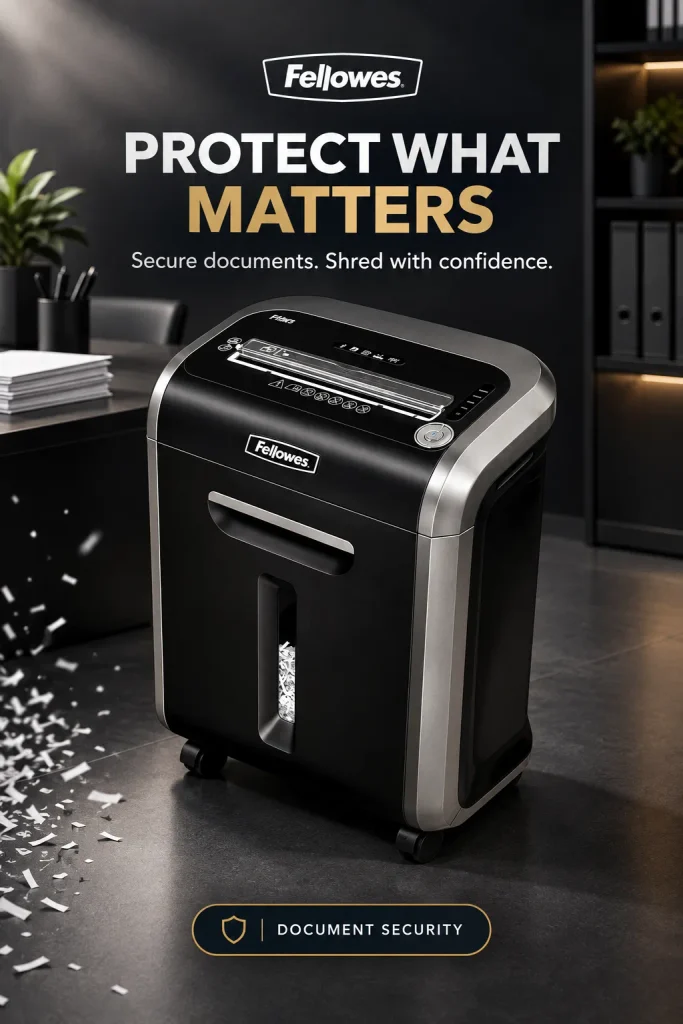
Best for Most Tax Filers: Fellowes Powershred 99Ci
The Fellowes Powershred 99Ci is a strong fit when your tax cleanup involves several folders and you want a higher feed capacity without moving into a much larger office machine.
Fellowes rates it for 18 sheets per pass, with P-4 cross-cut security, a 9-gallon pull-out bin, and a 30-minute run time. It can handle paper, staples, small paper clips, and credit cards according to the manufacturer’s documentation.
That combination makes it practical for a household that expects more than a few tax forms but doesn’t need a dedicated commercial shredder.
Best For: Households clearing several folders of tax and financial paperwork.
Main trade-off: It’s larger and more expensive than compact home shredders.
Verdict: Choose the 99Ci when your priority is getting through a substantial tax-season pile with a strong combination of capacity, runtime, and P-4 security.
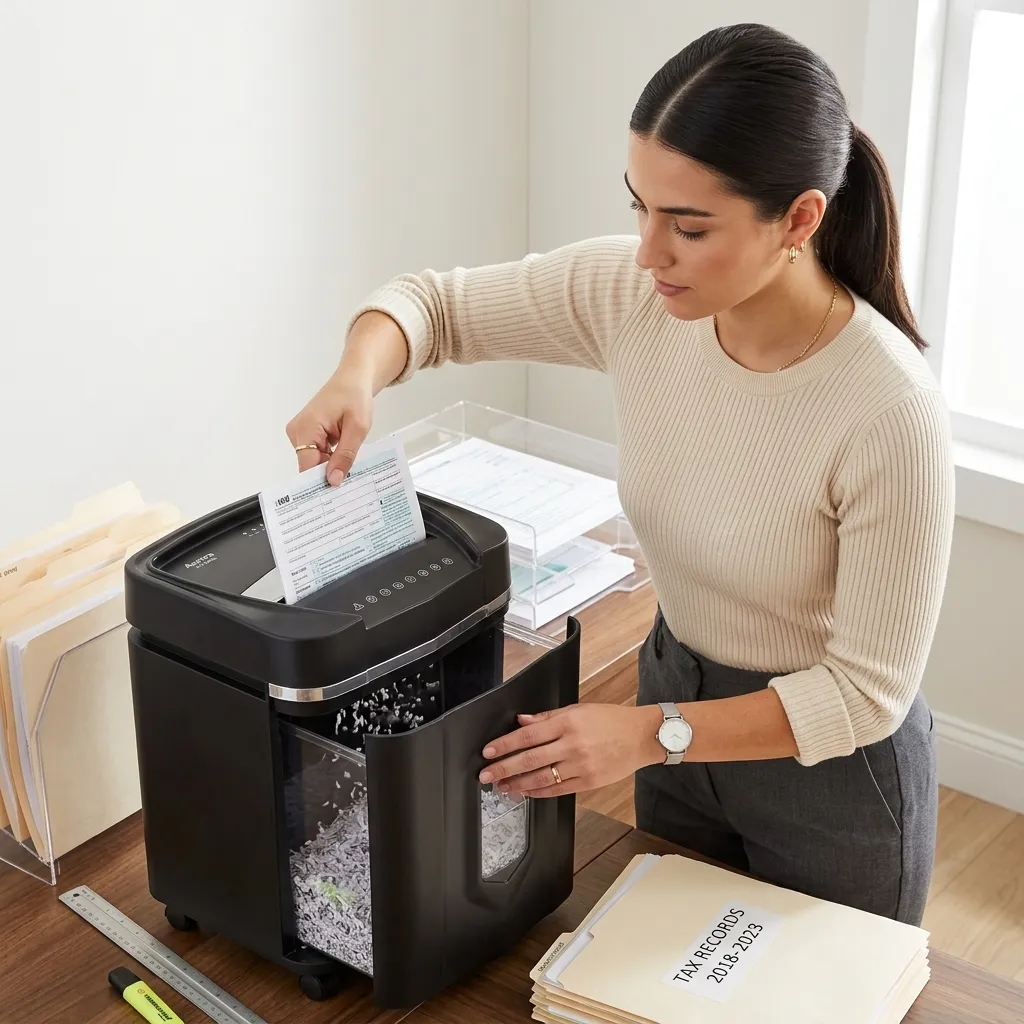
Best for Large Tax-Document Batches: Aurora AU1210MA
The Aurora AU1210MA takes a different approach. It accepts 12 sheets per pass, but Aurora specifies a 60-minute continuous run time, a 5-gallon pull-out bin, and P-4 micro-cut security.
That long operating window matters when you’re working through years of paperwork. You won’t necessarily feed as many sheets at once as the Fellowes 99Ci, but the longer stated runtime can make the machine better suited to an extended cleanup session.
Consumer Reports lists the AU1210MA as a 12-sheet micro-cut model with a 5-gallon bin and P-4 security. Its current listed price should be treated as variable rather than permanent.
Best For: Several folders of old tax paperwork and longer shredding sessions.
Main trade-off: Its 12-sheet feed capacity is lower than the 99Ci.
Verdict: Pick the AU1210MA when runtime matters more than maximum sheets per pass.
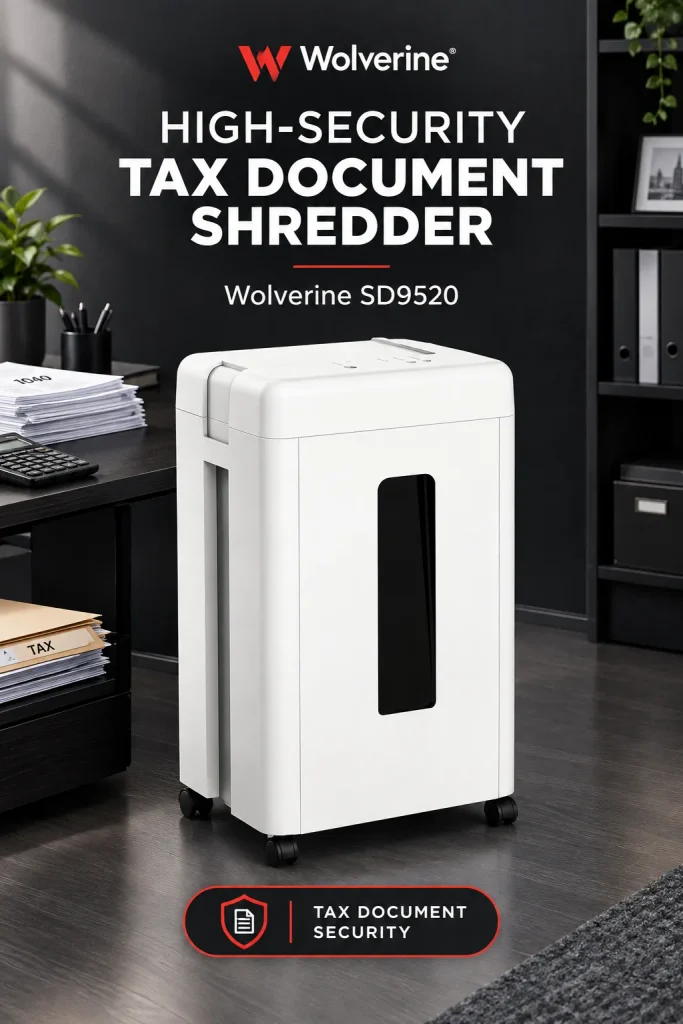
Best High-Security Tax Document Shredder: Wolverine SD9520
The Wolverine SD9520 is the security-focused option in this group.
Its published specifications list P-5 micro-cut security, a 15-sheet capacity, a 15-minute maximum continuous working time, and an 8-gallon bin. The manufacturer documentation lists a 2 mm by 10 mm particle size.
That P-5 classification makes it the pick to consider when you want finer-cut destruction for sensitive financial paperwork.
The trade-off is runtime. A 15-minute operating window can work well for controlled batches, but it’s less convenient than a machine designed for a longer continuous session.
Consumer Reports independently lists the SD9520 as a 15-sheet P-5 micro-cut model and reported a 15-minute manufacturer-rated run time with a 30-minute cooldown.
Best For: Readers who place a higher priority on finer particle size.
Main trade-off: The machine is heavy and requires more frequent breaks during long sessions.
Verdict: Choose it when P-5 security is more important to you than maximum runtime.
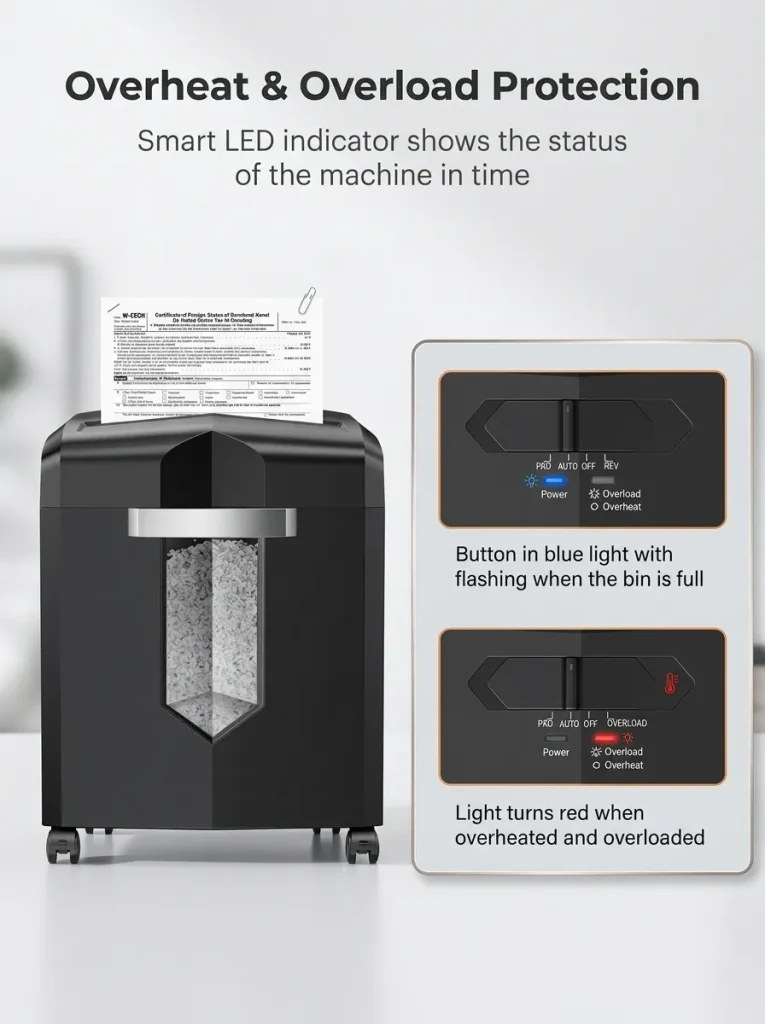
Best Budget Pick for Occasional Tax Cleanup: Bonsaii C266-B
The Bonsaii C266-B makes sense when your tax shredding is occasional but you still want P-4 micro-cut security.
Bonsaii lists 12-sheet capacity, P-4 security, a 60-minute maximum run time, a 20-minute cooling cycle, and the ability to handle staples, paper clips, credit cards, and CDs. The manufacturer’s current listed price is $109.99, though retailer pricing can change.
The 60-minute runtime is notable for a model positioned for home and small-office use. It gives occasional users more operating time than many compact machines.
Best For: Buyers who want P-4 micro-cut security and extended runtime without moving to a larger office shredder.
Main trade-off: You should verify current availability, warranty terms, and retailer pricing before purchase.
Verdict: This is the option to investigate when you want a relatively compact tax document shredder with a strong runtime specification.
For lower-cost options, see our paper shredders under $50.
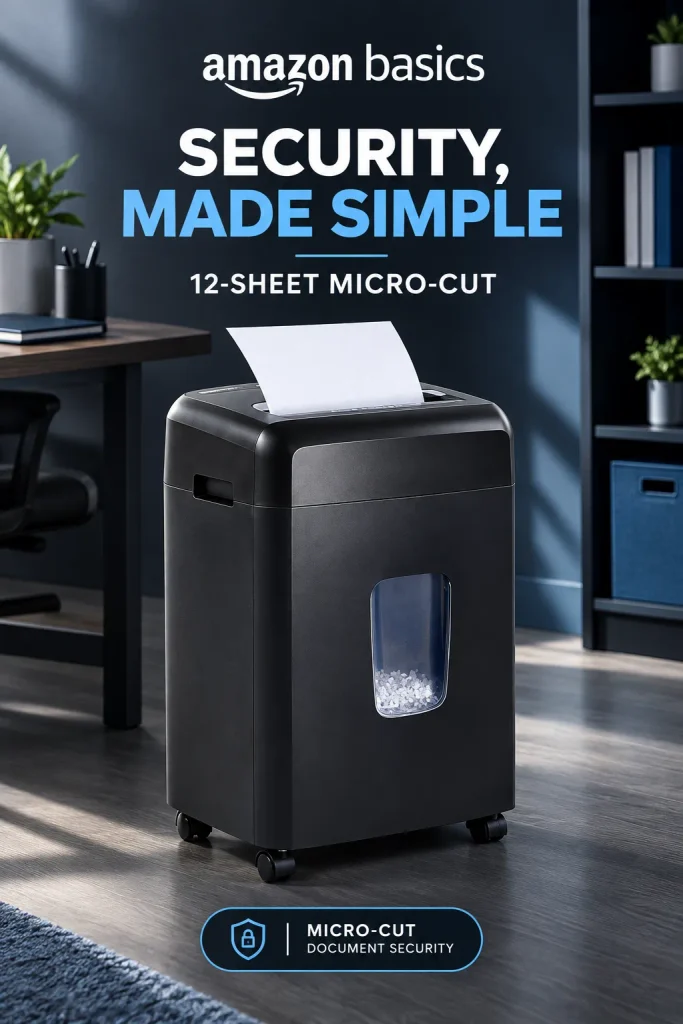
Best for Home Offices and Tax Preparers: Amazon Basics 12-Sheet Micro-Cut
The Amazon Basics 12-Sheet High-Security Micro-Cut is a practical option for readers who need one shredder for tax paperwork and routine sensitive documents throughout the year.
Consumer Reports lists this model at 12 sheets, P-4 security, and a 6-gallon bin. It can handle staples, paper clips, credit cards, and optical discs, and it includes wheels and a pull-out bin.
Its value comes from being useful beyond tax season. A home-office professional can use it for bank statements, client paperwork, receipts, and other sensitive paper without buying a machine dedicated to one annual cleanup.
For a tax preparer handling client paperwork every day, check the actual workload carefully. A household model may not provide the duty cycle, capacity, or service support that a professional office needs.
Best For: Home offices and moderate mixed paperwork.
Main trade-off: It is not the obvious choice for very large professional workloads.
Verdict: Consider it when you need a general-purpose P-4 micro-cut shredder for tax documents and everyday financial paperwork.
Which Security Level Do You Need for Tax Documents?
There isn’t one universal shredder security level that the IRS requires for every tax document.
Your choice should reflect the sensitivity of the information and any applicable organizational requirements.
| Situation | Starting Point |
|---|---|
| Ordinary personal tax paperwork | Consider P-4-class security |
| Financial records with sensitive identifiers | Consider finer-cut security |
| Higher-sensitivity records | Evaluate P-5 or the applicable requirement |
| Business or compliance records | Check the actual applicable standard |
P-4 and P-5 describe particle security classifications. They do not automatically determine whether a business satisfies HIPAA, FACTA, GDPR, or another legal requirement.
For personal tax records, P-4 is a sensible starting point for many buyers who want small particles rather than long strips. P-5 becomes more relevant when you deliberately want finer destruction.
If your organization has a specific regulatory or contractual requirement, check that requirement directly rather than treating a shredder’s P-level as a universal compliance certificate.
See our DIN 66399 / P-levels guide for the complete security-level explanation.
How Much Shredding Will You Actually Do?
Your workload can change the right choice more than the price of the machine.
Light: A Handful of Documents
If you’re clearing a small stack of expired statements, duplicate tax paperwork, or old mail, you don’t need a large office shredder.
A compact P-4 machine can handle this type of work. The key issue is avoiding a model with such a short runtime that a small pile turns into a long stop-and-start session.
Seasonal Purge: Several Folders or Years of Paperwork
This is where runtime becomes a major buying factor.
If you’re clearing several folders, calculate the job in terms of shredding time plus cooling time, not simply sheets per pass.
A 12-sheet machine with a long operating cycle can be more practical than an 18-sheet machine that repeatedly forces you to stop.
Professional: Tax Preparer or Accounting Office
A professional workload changes the calculation again.
You may need higher sheet capacity, longer duty cycles, larger bins, easier movement, and a warranty that fits repeated use.
Don’t buy a home shredder simply because its advertised sheet count looks impressive. The duty cycle and intended user count matter just as much.
For professional recommendations, see our shredders for accountants and tax preparers.
What Tax Documents Should You Shred?
Don’t shred a document simply because tax season ended.
First determine whether you still need it for federal tax purposes or another reason. The IRS says record-retention periods depend on the document and circumstances. For many ordinary federal income-tax situations, records supporting a return are generally kept for 3 years, but exceptions can extend the period to 6 or 7 years, or indefinitely in certain cases. Property records can require longer retention tied to the property.
The IRS also advises checking whether a record needs to be kept longer for a non-tax reason, such as insurance or creditor requirements.
The FTC gives consumers a similar practical message: keep sensitive records as long as needed, then shred paper documents containing personal or financial information when you no longer need them. Its consumer guidance identifies tax returns and related records such as W-2s, 1099s, receipts, and canceled checks as documents that may need to be retained for at least 3 years, with longer periods possible under IRS rules.
Documents You May Shred After the Applicable Retention Period
Examples can include:
- Old tax returns
- W-2 forms
- 1099 forms
- Tax-related receipts
- Canceled checks
- Pay stubs
- Bank statements
- Credit-card statements
The key phrase is after the applicable retention period. Don’t use a generic “three years and shred everything” rule.
Documents You Should Keep
Some records need longer retention or permanent storage.
The IRS specifically identifies property-related records as requiring special attention because they may support calculations involving basis, depreciation, or gain when property is sold.
The FTC separately recommends keeping certain vital records, including birth certificates, Social Security cards, passports, marriage records, wills, and other major life documents.
Documents With Special Retention Considerations
Property purchases, home improvements, business records, amended returns, unusual deductions, and other special circumstances can change the retention period.
If you’re unsure, check the applicable IRS guidance or ask a qualified tax professional before feeding the document into a shredder.
For the dedicated retention guide, see when to shred tax documents.
How We Choose Shredders for Tax Season
ShredProInk does not claim hands-on testing that hasn’t happened.
For this page, the evaluation framework compares manufacturer specifications, current product documentation, independent review data, verified-purchase feedback patterns, current availability and pricing, and fit for the tax-season workload.
We give extra weight to the specifications that matter during a seasonal purge: security level, particle size, sheet capacity, duty cycle, cooling time, bin size, jam handling, safety features, and warranty.
That approach follows ShredProInk’s methodology rule: recommendations should describe research that actually happened rather than invented first-person testing.
Tax-Season Shredder Buying Checklist
Before you buy a shredder for tax season, check these points:
- Cut type: Choose a cut that matches the sensitivity of your paperwork.
- Security level: Check the stated P-level and particle size.
- Sheet capacity: Match it to the thickness of your normal batches.
- Runtime: Check how long the machine can operate before cooling.
- Cooling time: A long cooldown can make a large purge frustrating.
- Bin capacity: Larger bins reduce emptying interruptions.
- Safety: Look for appropriate safety features for your workspace.
- Warranty: Check the current manufacturer’s warranty.
- Current price: Verify the live retailer price before purchasing.
Frequently Asked Questions
What Is the Best Shredder for Tax Documents?
For many households, the Fellowes Powershred 99Ci is a strong fit because it combines P-4 cross-cut security, an 18-sheet rated capacity, a 30-minute runtime, and a 9-gallon bin. The right choice changes if your priority is P-5 security, longer runtime, lower cost, or professional use.
Is P-4 Enough for Tax Documents?
P-4 is a reasonable starting point for many personal tax documents, but it is not a universal legal requirement. If you want finer particle destruction, a P-5 model such as the Wolverine SD9520 provides a higher security classification.
Should I Use a Micro-Cut Shredder for Tax Returns?
Micro-cut is a useful choice when you want smaller particles from sensitive financial paperwork. Check the model’s stated P-level and particle size rather than relying on the term “micro-cut” alone.
How Long Should I Keep Tax Documents Before Shredding?
The answer depends on the record and your circumstances. The IRS generally gives a 3-year period for many ordinary records supporting a tax return, but exceptions can extend that period to 6 or 7 years or longer.
Can I Shred Old W-2s?
You can consider shredding W-2s once you no longer need them and the applicable retention period has passed. The FTC specifically includes W-2s among tax-related records that may need to be retained for at least 3 years, with longer retention possible.
Can I Shred Bank Statements?
Yes, when you no longer need the paper statements and no other retention requirement applies. The FTC recommends shredding paper documents containing personal or financial information when they are no longer needed.
How Many Sheets Should a Tax-Season Shredder Handle?
For occasional household cleanup, a 10-12 sheet machine can be sufficient. If you’re clearing several folders, look closely at both sheet capacity and duty cycle because a high sheet rating doesn’t help much if the machine needs frequent cooldowns.
What Is the Best Shredder for Large Tax-Document Piles?
Look for a model with a longer duty cycle, reasonable sheet capacity, and a larger bin. The Aurora AU1210MA, with its stated 60-minute continuous runtime and 5-gallon bin, is built around longer shredding sessions.
Tax-Season Ready: Match the Machine to the Pile
The best shredder for tax documents is the one that matches the work in front of you.
For most household users, start with P-4 security and then compare sheet capacity, runtime, cooling time, and bin size. If you have several years of paperwork, give runtime more weight. If finer particle destruction is your priority, consider P-5.
Before you start shredding, check the applicable IRS retention period and any separate reason you may need to keep the document.
Then choose the machine that fits your actual pile, not the biggest specification on the product box.
Tax-Season Workload Scenario: A household clearing several years of old financial paperwork should compare the total operating cycle, not just the number of sheets the shredder accepts. A 12-sheet model with a long runtime may be easier to use than an 18-sheet model that requires frequent cooling.
Author
Author: ShredProInk Editorial Team
The ShredProInk editorial team researches paper shredder buying guides by cross-referencing manufacturer specifications, DIN 66399 security information, independent review data, and verified buyer feedback to help readers match a shredder to their document-security needs. See the Editorial Methodology page for the full recommendation process.