
If you’ve seen P-3, P-4, or P-5 on a paper shredder and wondered what those numbers actually mean, you’re looking at the shredder’s paper-security classification under DIN 66399.
The basic rule is simple: the higher the P-level, the smaller the permitted paper particles. P-1 allows much larger pieces than P-7, which requires particles no larger than 5 mm².
For most home and small-office buyers, the real question isn’t “What’s the highest P-level?” It’s “What security level matches the documents I actually shred?”
Quick answer: P-3 covers sensitive and confidential paper, P-4 provides finer destruction for more sensitive personal and business records, and P-5 and above are intended for increasingly sensitive information. Always check the manufacturer’s stated DIN 66399 classification rather than relying only on labels such as “cross-cut” or “micro-cut.”
How we built this guide: We compared the DIN/ISO security classifications with manufacturer specifications and shredder documentation, then translated the technical P-level requirements into practical buying guidance. We don’t claim hands-on testing unless we actually performed it.
See our complete methodology on how we test and rate shredders.
What Is DIN 66399?
DIN 66399 is a standard for the secure destruction of data carriers, including paper. For paper, the relevant classification begins with the letter P, followed by a security level from P-1 through P-7.
The P-level describes the required destruction characteristics of the paper after shredding. It isn’t a general score for the entire shredder.
That distinction matters when you’re shopping. A shredder can have a long run time, large bin, high sheet capacity, and a low noise rating, but those specifications don’t tell you what security level its paper output meets.
What the P in P-Levels Means
The P identifies paper and other information stored in original-size form within the DIN/ISO classification system.
The number identifies the security level. As the number rises, the permitted particle size becomes smaller.
Think of it as a destruction scale rather than a performance score:
P-1 → larger paper pieces → P-7 → much smaller paper particles
P-5 isn’t “five times more secure” than P-1. It represents a much finer destruction requirement.
DIN 66399 vs ISO/IEC 21964
You may see both names when researching shredder security.
DIN 66399 is the familiar German standard reference used throughout the document-destruction industry. The related international standard is ISO/IEC 21964, which covers principles and definitions, equipment requirements, and destruction processes.
ISO/IEC 21964-2 covers requirements for equipment used to destroy data carriers, while ISO/IEC 21964-3 addresses the destruction process itself.
For a consumer shopping for a paper shredder, the practical takeaway is simple: when a manufacturer states that a machine meets DIN 66399 P-4, P-5, or another P-level, verify the exact classification and particle specification in its documentation.
Why the Standard Matters When Buying a Shredder
Cut-type labels can be confusing.
“Cross-cut” and “micro-cut” describe how manufacturers commonly describe a machine’s cutting method or output. The DIN P-level gives you a more precise security reference.
That makes the P-level useful when you need to compare two shredders that use different marketing terminology.
If document security is the reason you’re buying, check these items in order:
- DIN security level
- Maximum particle size
- Cut type
- Sheet capacity
- Duty cycle and cooling time
- Bin capacity and maintenance requirements
The security level tells you about the destruction output. The remaining specifications tell you whether the machine will fit your workload. Explore the role shredding plays in privacy.
DIN 66399 P-Levels at a Glance
The table below gives the paper P-levels in one place. Particle area is the key measurement for particle-cut shredders, while lower levels can also be expressed through maximum strip width.
| P-Level | Maximum Particle Size | Strip Width Where Applicable | Typical Destruction | Practical Sensitivity | Buying Context |
|---|---|---|---|---|---|
| P-1 | ≤2,000 mm² | ≤12 mm | Strip cut | General information | Basic paper disposal |
| P-2 | ≤800 mm² | ≤6 mm | Strip cut | Internal information | Routine internal documents |
| P-3 | ≤320 mm² | ≤2 mm | Particle cut | Sensitive/confidential | Personal and confidential records |
| P-4 | ≤160 mm² | ≤6 mm for regular particles | Particle cut | More sensitive confidential data | Common higher-security office use |
| P-5 | ≤30 mm² | ≤2 mm for regular particles | Fine particle cut | Highly sensitive information | Sensitive financial, HR, or proprietary records |
| P-6 | ≤10 mm² | ≤1 mm for regular particles | High-security particle cut | Very high security | Specialized high-security use |
| P-7 | ≤5 mm² | ≤1 mm for regular particles | Highest paper-security level | Highest paper security | Extremely sensitive or classified material |
The exact particle requirements should be verified against the applicable standard and the manufacturer’s documentation before making a procurement decision.
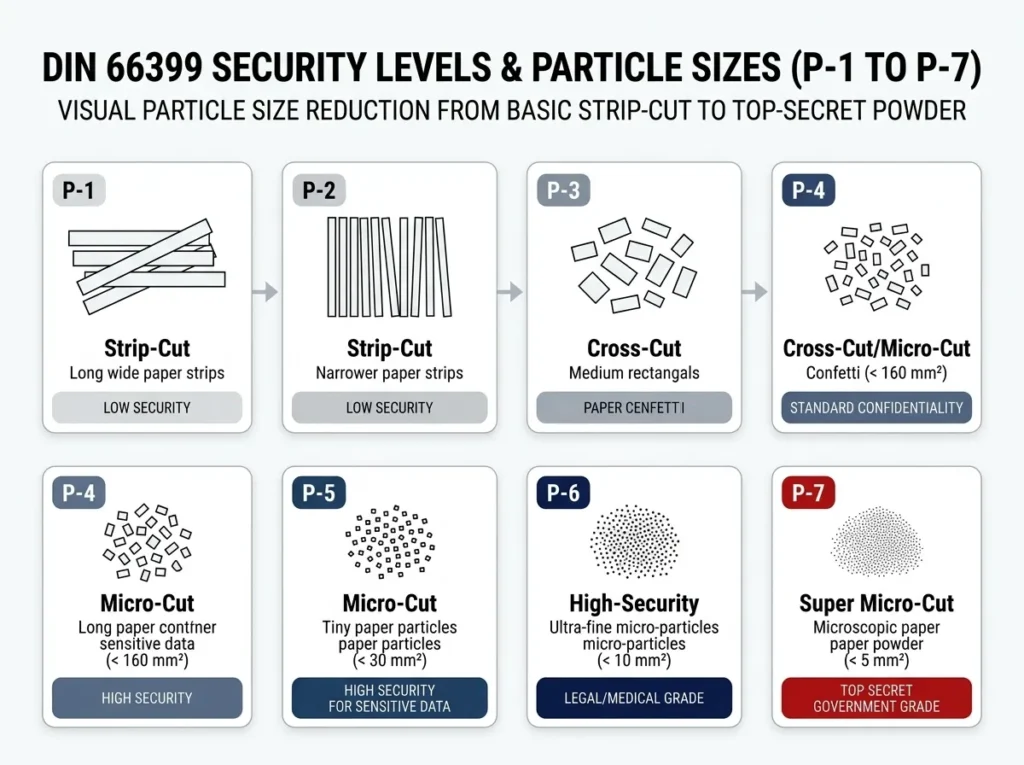
P-1 Through P-7 Explained
You don’t need seven long explanations to understand the scale. The table above does most of the work. Here’s what each level means in practical buying terms.
P-1: General Paper Destruction
P-1 allows paper particles up to 2,000 mm² or strips up to 12 mm wide.
This is the lowest paper-security level in the DIN 66399 scale. It fits documents where reconstruction resistance isn’t a major concern.
If your documents contain names, account numbers, addresses, or other personal information, don’t select a shredder simply because it has the lowest price. Move up the security scale when the information warrants finer destruction.
P-2: Basic Internal Documents
P-2 reduces the maximum particle or strip size compared with P-1.
It can make sense for routine internal material that isn’t highly sensitive. Examples might include ordinary internal communications or documents with little or no personal information.
The right choice depends on the information being destroyed, not simply the office where the shredder sits.
P-3: Sensitive and Confidential Documents
P-3 allows particles up to 320 mm² or strips up to 2 mm wide.
This is where the paper security discussion becomes more relevant to everyday privacy. P-3 is intended for sensitive and confidential information.
If you’re shredding documents containing personal or confidential business information, P-3 gives you a defined security classification rather than relying on a generic “secure shredder” label.
P-4: Higher-Security Confidential Documents
P-4 reduces the maximum particle area to 160 mm².
P-4 is widely encountered in office shredders because it provides substantially finer destruction than P-3 without moving into the very fine particle sizes of P-5 and above.
This makes P-4 particularly relevant when you’re comparing shredders for personal information, financial paperwork, customer records, or routine business documents.
Don’t assume every machine described as “micro-cut” is P-5. Verify the actual DIN classification.
P-5: Highly Sensitive Information
P-5 limits paper particles to 30 mm².
That’s a significant reduction from P-4.
P-5 becomes relevant when the consequences of information exposure justify finer destruction, such as particularly sensitive financial, personnel, proprietary, or other confidential records.
The smaller output comes with a practical trade-off. A finer cut can affect throughput, sheet capacity, run time, and price depending on the machine.
P-6: Very High Security
P-6 reduces the maximum particle area to 10 mm².
This is a specialized level rather than a typical requirement for household shredding.
If your organization genuinely needs P-6, verify the exact requirement rather than assuming that simply buying a higher-numbered shredder solves the entire document-security problem.
P-7: Highest Paper Security Level
P-7 allows paper particles no larger than 5 mm².
P-7 sits at the top of the DIN 66399 paper-security scale.
This level is intended for situations requiring extremely fine paper destruction. The purchase decision should be based on the applicable security requirement and the exact machine specification, not on the assumption that P-7 is automatically appropriate for every sensitive document.
What P-Level Do You Actually Need?
The right paper shredder security level depends on the sensitivity of the material, your workflow, and any requirements that apply to your organization.
For Ordinary Household Paper
If you’re destroying ordinary paper with little sensitive information, a lower P-level may be sufficient.
Once documents contain personal information, financial details, account numbers, or other data you don’t want reconstructed, look beyond P-1 and P-2.
For household buyers who want a stronger privacy margin, P-3 or P-4 may be more relevant depending on the documents involved.
For Tax and Financial Documents
Tax returns, bank statements, pay stubs, investment records, and similar paperwork can contain information that deserves more careful destruction.
The important question isn’t whether a shredder is marketed as a “tax document shredder.” It’s what DIN P-level and particle size does it actually produce?
For a seasonal tax purge, remember that security isn’t your only requirement. You also need enough sheet capacity, run time, bin space, and cooling performance to finish the workload without constant interruptions.
For Home Offices
Home-office users often handle both personal and client paperwork.
That makes the security decision different from shredding ordinary household mail. If your workload includes invoices, client records, financial documents, or other confidential material, look at the P-level alongside noise, duty cycle, capacity, and bin size.
A security rating doesn’t tell you whether the shredder will survive your weekly workload.
For Small Businesses
Small businesses need to think about both information sensitivity and operating volume.
A shredder that produces suitably small particles but overheats after a short run may create more downtime than a business wants.
Match the P-level to the documents, then compare:
- Sheet capacity for how much paper enters per pass
- Duty cycle for how long the machine can operate
- Cooling time for recovery between workloads
- Bin capacity for fewer emptying interruptions
- Maintenance requirements for ongoing use
For Medical and Legal Records
Medical and legal documents can contain highly sensitive personal information.
However, DIN 66399 does not itself certify a shredder as HIPAA-compliant or legally compliant.
For regulated records, identify the applicable requirement first, then select a destruction method and machine that support your organization’s documented process.
For Highly Sensitive or Classified Material
P-6 and P-7 are specialist security levels.
If you’re handling material subject to a government, contractual, organizational, or classified-destruction requirement, don’t select a machine based only on a consumer product listing.
Verify the exact particle specification, applicable requirement, equipment documentation, and destruction process.
P-3 vs P-4 vs P-5: What’s the Practical Difference?
For many buyers, this is the most useful comparison.
| Factor | P-3 | P-4 | P-5 |
|---|---|---|---|
| Maximum particle area | ≤320 mm² | ≤160 mm² | ≤30 mm² |
| Typical terminology | Cross-cut/particle cut | Cross-cut or fine particle cut | Often micro-cut |
| Destruction | Sensitive/confidential | More sensitive confidential | Highly sensitive |
| Particle size | Larger | Smaller | Much smaller |
| Workflow trade-off | Often easier throughput | Moderate balance | Greater security can reduce throughput |
| Typical fit | General confidential documents | Sensitive personal/business records | Highly sensitive records |
The key difference is particle size.
P-4 cuts the maximum particle area in half compared with P-3. P-5 then reduces the maximum particle area to 30 mm², making the jump from P-4 to P-5 much larger than the difference between their numbers suggests.
Don’t choose between P-3, P-4, and P-5 based on the label alone. Check the manufacturer’s exact DIN classification and particle dimensions.
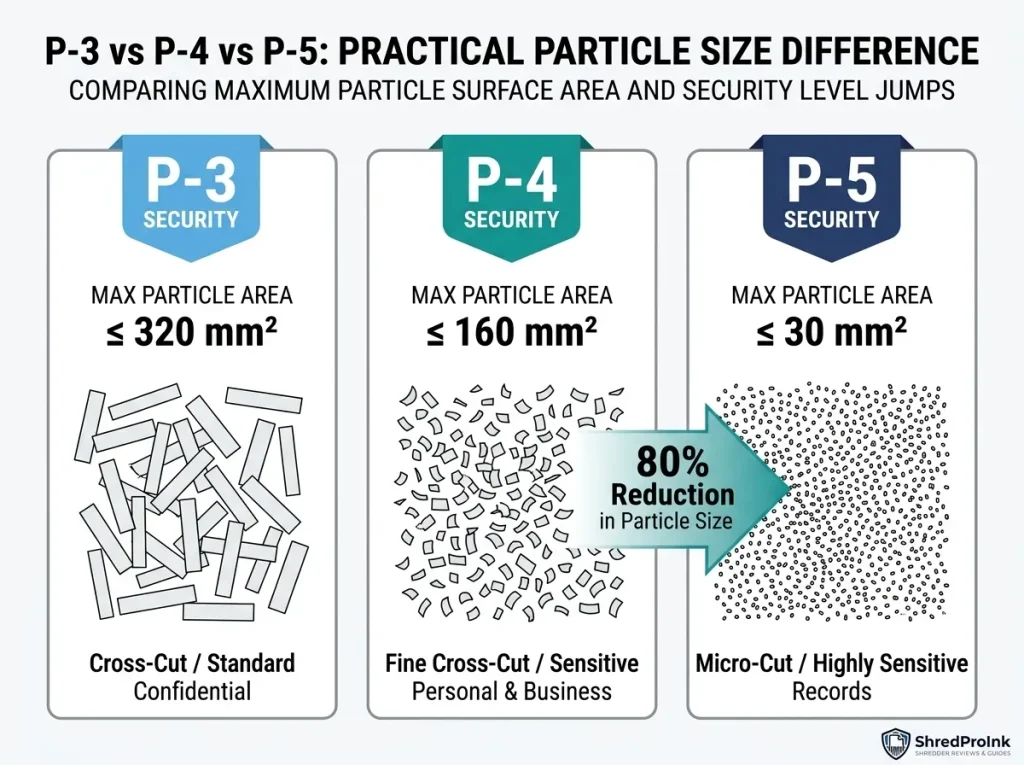
DIN P-Level vs Cross-Cut vs Micro-Cut
These terms describe related but different things.
Why “Micro-Cut” Can Be Confusing
“Micro-cut” isn’t a substitute for a DIN P-level.
Manufacturers and retailers can use cut-type terminology differently. A machine marketed as micro-cut may not necessarily have the same DIN classification as another machine carrying the same marketing label.
That’s why shredder P levels are the better reference when security classification matters.
Why You Should Check the P-Level
Suppose two product listings both say “micro-cut.”
One may specify P-4. Another may specify P-5.
Those aren’t equivalent security classifications.
The useful comparison is:
What DIN P-level does the manufacturer state, and what particle size does the machine produce?
That gives you a much clearer basis for comparison than marketing terminology alone.
Particle Size Matters More Than Marketing Labels
If you’re choosing a shredder for document security, look for the actual specification.
Don’t stop at:
- “Micro-cut”
- “High security”
- “Confidential”
- “Secure shredding”
Instead, look for a stated DIN 66399 P-level and particle-size specification.
That one habit can prevent you from paying more for a label without getting the security classification you expected. See our micro-cut security picks.
Does a Higher P-Level Always Mean a Better Shredder?
No. It means finer paper destruction.
That’s useful when your documents require it, but finer destruction isn’t the only factor that determines whether a shredder is right for you.
As particle size decreases, the machine may face greater processing demands. The actual effect varies by model, so verify the specifications rather than assuming every P-5 machine behaves the same way.
Compare:
- Security level
- Sheet capacity
- Speed
- Duty cycle
- Cooling time
- Bin size
- Noise
- Maintenance
- Price
A P-7 machine can be completely unnecessary for someone shredding routine household mail. A P-3 machine can be a poor fit for an organization whose documented requirement calls for finer destruction.
The goal is appropriate security, not the highest number on the label.
An Illustrative Case: Choosing Between P-3, P-4, and P-5
Consider a small home office where one person regularly handles invoices, bank statements, tax paperwork, and client documents.
A P-3 machine may provide a defined security level for sensitive and confidential paper. Moving to P-4 produces smaller particles and gives the buyer a higher destruction threshold.
If the same person begins handling particularly sensitive personnel, financial, or proprietary information, P-5 may become worth considering.
The point isn’t that every home office should buy P-5.
The decision changes when the sensitivity of the documents changes.
This is an illustrative buying scenario, not a report of a ShredProInk customer or hands-on test.
Shredders by Security Level
Instead of treating this page like a “best shredders” roundup, use the P-level as the starting filter.
| Security Level | Best Suited To | What to Verify | Next Step |
|---|---|---|---|
| P-3 | Sensitive and confidential documents | DIN rating and particle size | Compare P-3 models |
| P-4 | Sensitive personal and business records | Exact DIN classification | Check P-4 options |
| P-5 | Highly sensitive information | Particle size, capacity, run time | Compare P-5 models |
| P-6 | Very high-security requirements | Exact specification and applicable requirement | Verify specialist models |
| P-7 | Highest paper-security requirements | Exact specification and applicable requirement | Verify specialist models |
For current product recommendations, use this security-level framework together with the paper shredder buying guide. Product availability, pricing, and manufacturer specifications can change, so those details should be verified before publication.
DIN 66399 and Compliance: What It Does and Doesn’t Tell You
A DIN P-level describes the physical destruction characteristics of paper.
It does not automatically certify your entire document-destruction process as compliant with HIPAA, GDPR, FACTA, or another law or regulation.
HIPAA and Medical Records
The U.S. Department of Health and Human Services says covered entities must apply appropriate safeguards when disposing of protected health information. Paper PHI can be shredded or otherwise destroyed so it becomes essentially unreadable, indecipherable, and not reconstructable.
HHS does not state that a particular DIN P-level automatically makes a shredder HIPAA-compliant.
“P-5 describes the shredder’s paper-destruction level. Your HIPAA disposal obligations depend on your complete document-destruction process and applicable requirements.”
GDPR and Personal Data
GDPR Article 32 requires appropriate technical and organizational measures based on the risk associated with processing personal data.
That is broader than the particle size produced by a shredder.
A P-level can be one part of a document-destruction process, but it doesn’t establish GDPR compliance by itself.
FACTA and Financial Information
The FTC’s Disposal Rule requires covered businesses and individuals to take reasonable measures when disposing of sensitive information derived from consumer reports.
The FTC gives shredding, burning, or pulverizing paper as examples of disposal methods that can prevent information from being read or reconstructed.
Again, the rule is about reasonable disposal measures, not a single shredder P-level.
Why a P-Level Alone Does Not Certify Compliance
Think of it this way:
P-level = physical destruction characteristic
Compliance = physical destruction + applicable rules + policies + procedures + handling
If compliance is part of your purchase decision, verify the requirement that applies to your organization before choosing the machine.
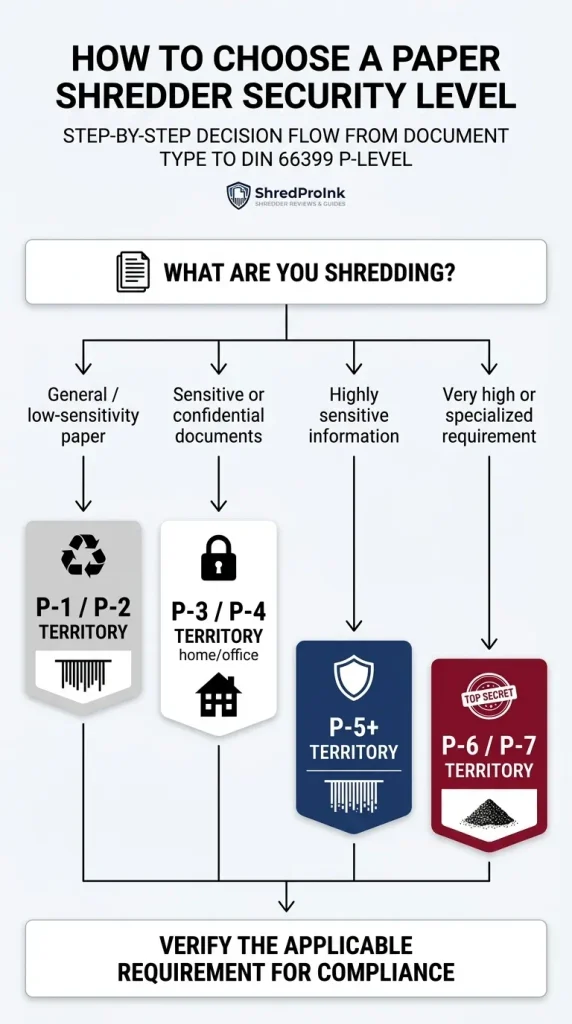
How to Choose a Shredder by Security Level
Use this four-step process before comparing products:
- Identify your most sensitive document.
Look at what you actually plan to destroy, not the average sheet of paper. - Determine the applicable security requirement.
Check whether your organization has a documented policy, contract requirement, industry requirement, or regulatory obligation. - Select the corresponding P-level.
Compare the required level with the manufacturer’s stated DIN classification and particle size. - Check the ownership specifications.
Compare sheet capacity, duty cycle, cooling time, bin size, speed, noise, and maintenance.
If you’re still comparing actual machines, move from the security question to the broader buying decision in our complete paper shredder buying guide.
Frequently Asked Questions
What Does P-Level Mean on a Paper Shredder?
The P-level identifies the paper-destruction security level under the DIN 66399 classification. P-1 permits larger paper pieces, while P-7 requires much smaller particles.
What Is DIN 66399?
DIN 66399 is a standard covering the secure destruction of data carriers, including paper. The P classification covers paper and uses levels P-1 through P-7.
What Is the Difference Between P-3 and P-4?
P-3 permits paper particles up to 320 mm², while P-4 permits particles up to 160 mm². P-4 therefore requires finer paper destruction than P-3.
Is P-4 Better Than P-3?
P-4 provides finer paper destruction than P-3. Whether that makes it the right choice depends on the sensitivity of your documents and your workload.
What P-Level Is Best for Home Use?
There isn’t one P-level that fits every household. Match the security level to the documents you shred. If your household material includes sensitive financial or personal information, compare P-3 and P-4 rather than choosing based only on price.
What P-Level Is Recommended for Sensitive Financial Documents?
P-3 and P-4 are relevant levels to compare for sensitive financial documents, with P-4 providing finer destruction. Your specific requirements may call for a different level, so verify the applicable policy or requirement before buying.
Is Micro-Cut the Same as P-5?
No. “Micro-cut” is a product or cut-type description, while P-5 is a DIN 66399 paper-security classification. Some machines marketed with micro-cut terminology may carry different P-level classifications.
Does a P-Level Make a Shredder HIPAA Compliant?
No. A P-level describes the physical destruction of paper. HIPAA compliance depends on the applicable requirements and the organization’s complete safeguards and disposal process.
Final Takeaway
DIN 66399 security levels explained simply: P-1 through P-7 describe increasingly fine paper destruction, with P-7 allowing the smallest paper particles.
For most buyers, the useful question isn’t which P-level sounds most secure. It’s which level matches the sensitivity of the documents you actually destroy.
Check the DIN P-level and particle size first, then compare capacity, duty cycle, bin size, noise, maintenance, and price.
If you want to move from security level to the actual buying decision, continue with our complete paper shredder buying guide. If you already know you want finer particle destruction, compare our cross-cut and micro-cut shredder options before choosing a machine.
Disclaimer: This article explains general DIN 66399 and regulatory concepts. It is not legal advice or a certification of compliance. Organizations handling regulated information should confirm their specific requirements with their compliance officer or counsel.
Affiliate Disclosure: As an Amazon Associate, ShredProInk earns from qualifying purchases. We may earn a commission if you buy through our links, at no extra cost to you.
Author: William Dahlberg
William Dahlberg researches and writes ShredPro Ink’s paper shredder buying guides, cross-referencing manufacturer specifications, DIN 66399 security ratings, independent reviews, and verified buyer feedback to help readers match a shredder to their actual document-security needs. See our Editorial Methodology for how recommendations are researched and published.